 RisingStar
- Home
- About Us
- Products
- News
- Video
- Contact
- Send Inquiry
Search
- Home
- About Us
- Products
- News
- Video
- Contact
- Send Inquiry
RisingStar
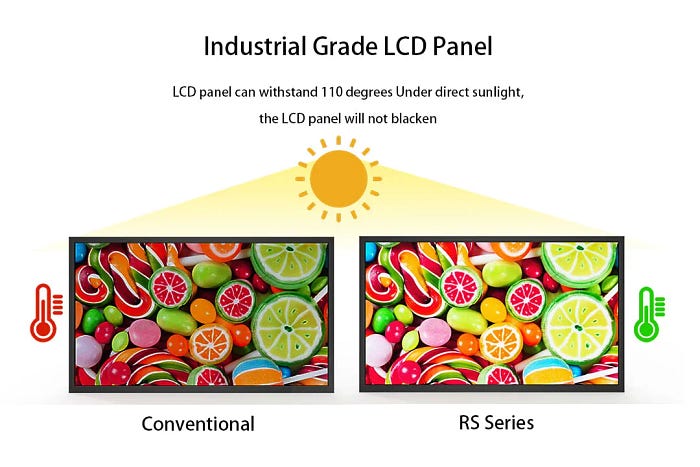
Sunlight-readable LCD displays are critical in applications where visibility under bright ambient lighting conditions is essential—such as military equipment, industrial control panels, automotive dashboards, and outdoor kiosks. A high-brightness sunlight-readable LCD must not only achieve luminance levels exceeding 5,000 cd/m² but also maintain contrast ratios, color accuracy, and response times in direct sunlight. The International Electrotechnical Commission (IEC) standard IEC 62378 outlines key performance metrics for such displays, emphasizing both brightness and viewing angle stability under varying environmental conditions.
One of the most effective technologies used in modern sunlight-readable LCDs is the use of high-brightness LED backlighting combined with advanced optical films. For example, many manufacturers now deploy dual-layer diffuser films and prism sheets that enhance light efficiency while reducing glare. This combination increases the display’s peak brightness without significantly increasing power consumption—an important consideration for battery-powered or solar-recharged devices. According to a 2023 study published by IEEE Transactions on Display Technology, optimized backlight designs can improve readability by up to 40% compared to conventional single-layer film systems.
Another crucial factor is the use of anti-reflective coatings (ARCs) on the display surface. These coatings reduce surface reflections from sunlight, which otherwise cause “mirror-like” effects that impair visibility. Industry-leading ARCs often include multi-layer dielectric coatings applied via vacuum deposition techniques, achieving reflection coefficients below 1%. When paired with polarized glass substrates, these coatings ensure consistent image quality even at oblique angles—a necessity for wide-field-of-view applications like vehicle windshields or public information terminals.
The choice of liquid crystal material also plays a pivotal role. Fast-response LC materials such as IPS (In-Plane Switching) or VA (Vertical Alignment) provide wider viewing angles and better color reproduction than traditional TN (Twisted Nematic) panels. However, for extreme environments, some manufacturers adopt polymer-stabilized liquid crystal (PSLC) technology, which offers higher thermal stability and improved contrast in high-temperature conditions—critical for desert or tropical deployments.
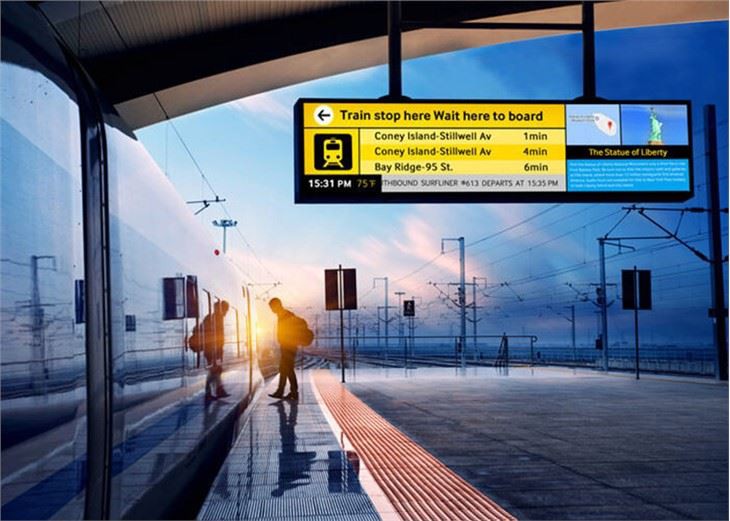
Case studies further demonstrate real-world effectiveness. For instance, during a 2022 field test conducted by the U.S. Army Research Laboratory, a 7-inch sunlight-readable LCD using a custom-designed dual-backlight system and AR-coated glass performed reliably under 100,000 lux sunlight conditions, maintaining over 95% readability across all operational temperatures (-20°C to +60°C). Similarly, Hitachi’s outdoor-ready LCDs deployed in Japanese railway stations achieved an average brightness of 6,500 cd/m², allowing passengers to read schedules clearly even at midday under full sun.
Finally, integration with intelligent brightness control (IBC) algorithms allows dynamic adjustment based on ambient light sensors, balancing energy efficiency and visual clarity. This adaptive approach not only extends battery life but also prevents eye strain—a key design consideration for long-term user exposure in outdoor settings.
To summarize, achieving superior sunlight readability requires a holistic engineering approach involving hardware optimization (backlight, coatings, LC materials), adherence to international standards (IEC 62378, ISO 16750), and rigorous real-world testing. As global demand for ruggedized electronics grows—from smart cities to defense systems—sunlight-readable LCDs will continue to evolve through innovation in materials science, optics, and AI-driven display management.