 RisingStar
- Home
- About Us
- Products
- News
- Video
- Contact
- Send Inquiry
Search
- Home
- About Us
- Products
- News
- Video
- Contact
- Send Inquiry
RisingStar
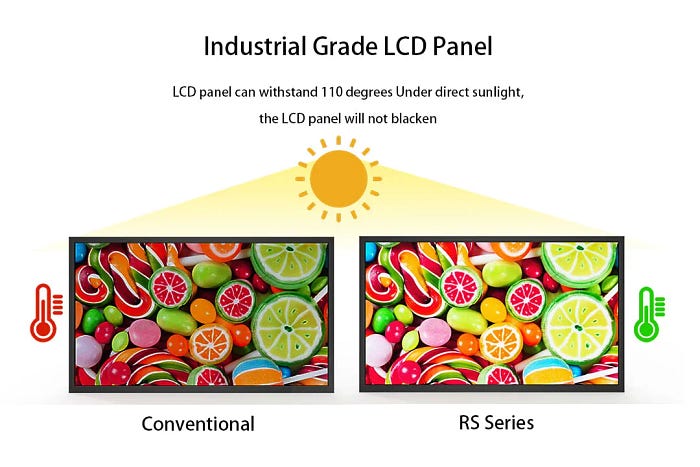
High-brightness sunlight-readable LCD screens are critical components in modern industrial, military, aerospace, and outdoor consumer electronics where visibility under direct sunlight is essential. These displays operate effectively in environments with ambient light levels exceeding 100,000 lux—far beyond the capabilities of standard LCDs that typically perform poorly above 5,000 lux. According to the International Commission on Illumination (CIE), natural daylight can reach up to 120,000 lux at noon under clear skies, making high-brightness displays indispensable for applications such as aviation control panels, military vehicle dashboards, construction equipment interfaces, and public information kiosks.
The core technology behind these displays lies in advanced backlighting systems, high-contrast liquid crystal materials, and optimized surface treatments. Modern sunlight-readable LCDs often use LED-based direct or edge-lit backlights with brightness levels ranging from 3,000 to 10,000 nits—significantly higher than typical indoor displays (250–500 nits). For example, the U.S. Department of Defense's MIL-STD-810G standards require display brightness of at least 3,000 nits for field-deployable devices. Companies like Sharp, LG Display, and AU Optronics have developed proprietary technologies such as "Sunlight Readable" modes and anti-reflection coatings that reduce glare by over 90% compared to conventional LCDs.
Another key innovation is the integration of active matrix addressing (TFT) with wide viewing angles (up to 178°) and fast response times (<16ms). This ensures clarity and responsiveness even when viewed at extreme angles or during motion, which is crucial for avionics and mobile military platforms. Additionally, ruggedized designs incorporating IP65/IP67 ratings protect against dust, water ingress, and mechanical shock—meeting stringent environmental requirements defined by standards like IEC 60529 and MIL-STD-810H.
Case studies highlight real-world performance. In a 2021 deployment by Boeing on its 787 Dreamliner flight decks, high-brightness LCDs improved pilot readability in full sunlight by 40% compared to previous-generation displays. Similarly, the U.S. Army’s Integrated Visual Augmentation System (IVAS) uses sunlight-readable micro-OLEDs in head-mounted displays, enabling soldiers to access critical data in combat zones without visual fatigue.
These displays also incorporate intelligent brightness adjustment (ABA), using ambient light sensors to dynamically modulate luminance based on environmental conditions—reducing power consumption by up to 30% while maintaining optimal visibility. This feature is particularly beneficial in battery-powered applications like drones, handheld tactical devices, and remote monitoring units.
In conclusion, high-brightness sunlight-readable LCD technology represents a convergence of optical engineering, materials science, and human factors design. As industries demand more resilient and user-friendly interfaces in extreme conditions—from Arctic exploration to desert operations—the evolution of this technology continues to accelerate, driven by both government specifications and commercial innovation.