RisingStar
- Home
- About Us
- Products
- News
- Video
- Contact
- Send Inquiry
Search
- Home
- About Us
- Products
- News
- Video
- Contact
- Send Inquiry
RisingStar
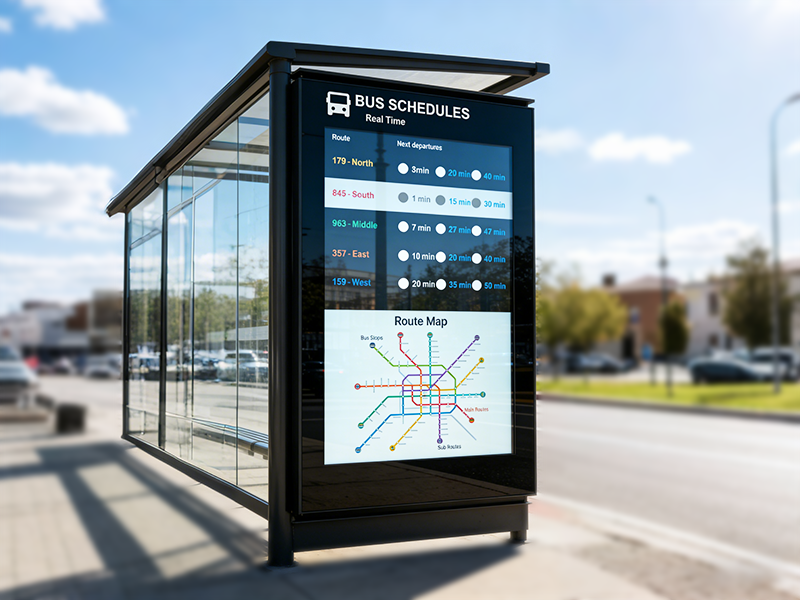
A passenger information display is a digital screen installed at transit locations — bus stops, railway platforms, airport terminals, and ferry docks — that shows arrival times, departure schedules, route maps, service alerts, and emergency notifications to waiting passengers.
Unlike traditional static timetable boards, a passenger information display connects to a central data source and updates content automatically. When a bus is delayed, the display shows the revised arrival time. When a train platform changes, the display updates instantly. When an emergency requires evacuation instructions, the display broadcasts the message across the entire network.
For transit operators, choosing the right passenger information display hardware directly impacts readability, reliability, and maintenance costs — and ultimately, passenger satisfaction.
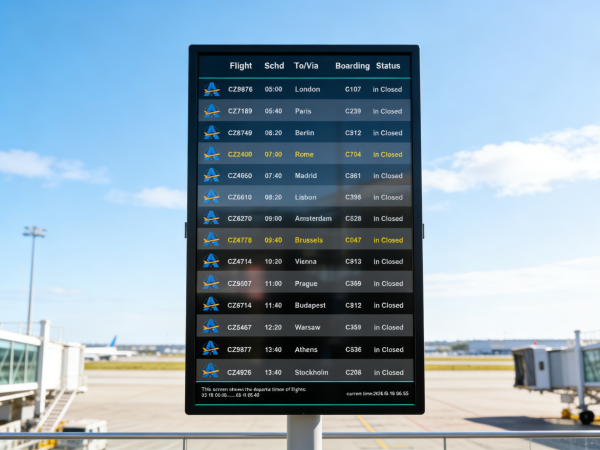
Choosing a passenger information display for outdoor or semi-outdoor transit environments requires careful evaluation of several hardware specifications. Below are the most important factors to consider.
The Challenge:
A passenger information display installed at an open-air bus stop or railway platform must compete with ambient sunlight that can exceed 100,000 lux on a clear day. Standard LCD panels (300–500 nits) become completely unreadable under these conditions.
What to Look For:
| Installation Environment | Recommended Brightness |
|---|---|
| Open-air bus stops, exposed platforms | 3000–5000 nits |
| Sheltered bus stops, covered platforms | 1500–2500 nits |
| Indoor terminals, enclosed stations | 700–1500 nits |
RisingStar's outdoor passenger information displays deliver up to 5000 nits brightness, ensuring arrival times and route info stay clearly visible even in direct midday sun. Built-in ambient light sensors automatically adjust brightness — maximum during daylight hours, reduced at night — optimizing energy consumption without sacrificing readability.

The Challenge:
Outdoor passenger information displays face rain, snow, dust, coastal salt spray, and industrial pollution. Moisture ingress is one of the leading causes of display failure in transit installations.
What to Look For:
IP65 rating: Protected against dust ingress and low-pressure water jets from any direction
IP66 rating: Protected against dust ingress and powerful water jets — recommended for coastal and high-rainfall regions
Fully sealed enclosure: Gasketed access panels, waterproof connectors, and corrosion-resistant internal coatings
RisingStar's outdoor passenger information displays carry IP65/IP66 ratings with fully sealed enclosures engineered for 24/7 operation in rain, snow, sandstorms, and coastal salt spray conditions.
The Challenge:
A passenger information display installed outdoors must function reliably across the full range of local climate conditions. In summer, direct sunlight can raise the display surface temperature to 70°C. In winter, displays in northern regions face temperatures below -20°C.
Standard LCD panels are rated for 0°C to 40°C and can malfunction outside this range. Additionally, standard panels develop permanent black spots ("blackening") when the liquid crystal material exceeds approximately 70°C.
What to Look For:
Operating temperature range: -20°C to 70°C minimum
Intelligent thermal management: Built-in heating elements for cold climates and ventilation fans for hot conditions
RisingStar displays incorporate Hi-Tni Heat Resistant technology, preventing panel blackening at surface temperatures — essential for passenger information displays installed in tropical, desert, and high-solar-radiation regions.
The Challenge:
A passenger information display must be large enough to read from the typical waiting distance at a transit location, but not so large that it overwhelms the installation space or exceeds the budget.
Sizing Guidelines:
| Application | Recommended Size | Typical Viewing Distance |
|---|---|---|
| Compact bus stop | 21.5"–32" | 3–5 meters |
| Standard bus stop | 43" | 5–10 meters |
| Major station platform | 55"–65" | 10–20 meters |
| Transit hub main board | 75"–86" | 20–40 meters |
| Platform edge / shelter header | 37"–49.5" (stretch bar) | 5–15 meters |
For narrow installation spaces such as bus shelter headers and platform edges, stretch bar displays with ultra-wide aspect ratios (e.g., 1920×720 or 3840×360) provide route-specific information in a compact form factor.
What to Look For:
IPS or AHVA panel technology: Wide viewing angles (80°+ from all directions) ensure readability for passengers approaching from different angles
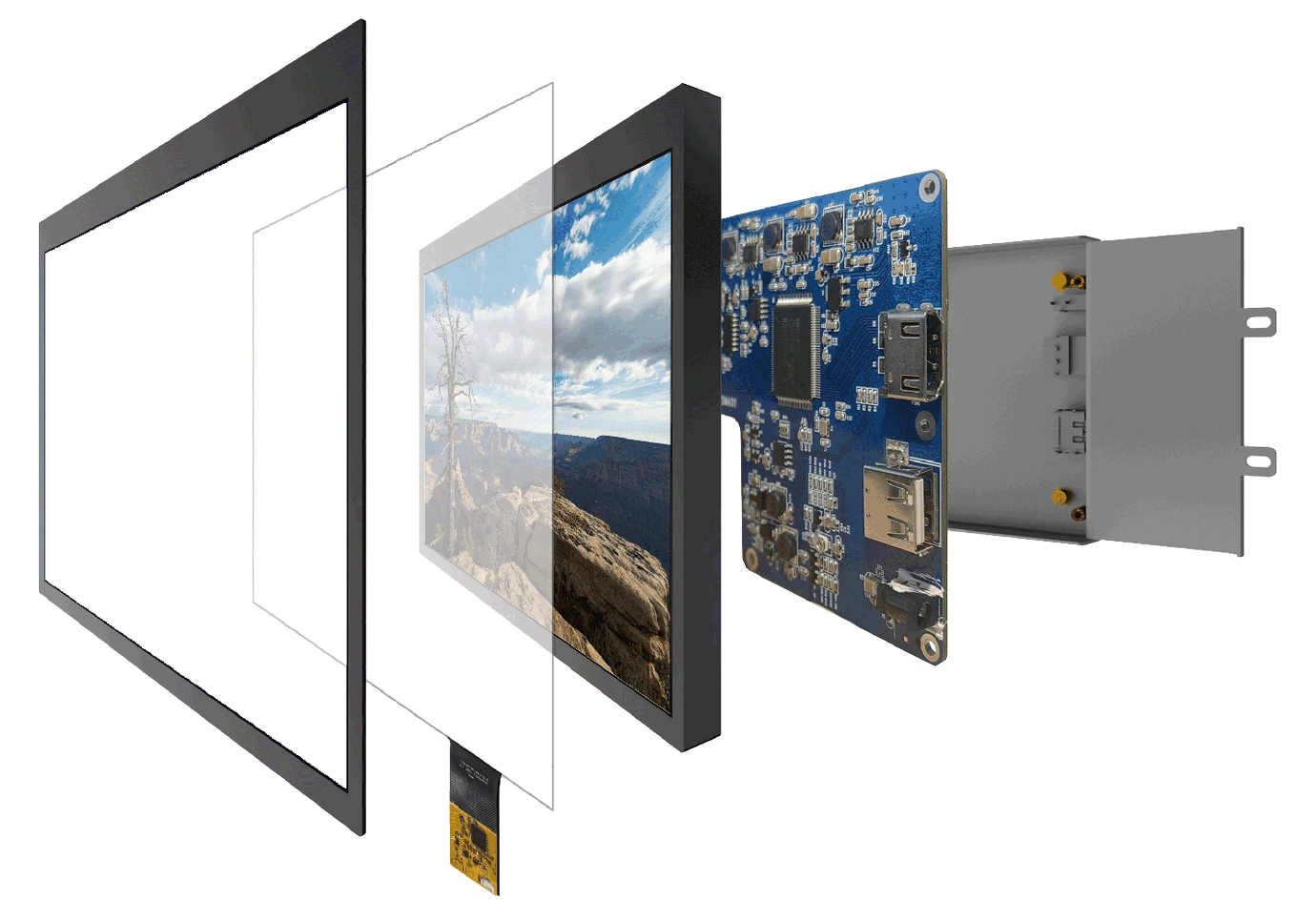
Optical bonding: Eliminates the air gap between the LCD panel and cover glass, reducing internal reflection by approximately 80% and preventing fogging during temperature transitions
Anti-glare (AG) coating: Reduces surface reflection from sunlight and artificial lighting
A/A+ grade panels: Sourced from tier-1 manufacturers (LG Display, AUO, Innolux, BOE, Tianma) for consistent quality and long-term reliability
What to Look For:
Backlight lifespan: up to 50,000 hours
Direct-lit LED backlight: More energy-efficient and longer-lasting than older CCFL or edge-lit LED designs
Energy consumption: Look for displays with smart auto-dimming to reduce power usage during evening hours
RisingStar's passenger information displays use direct-lit LED backlight technology that reduces power consumption by approximately 35% compared to edge-lit designs, lowering operating costs across large display networks.
Based on typical transit deployment scenarios, here are our most commonly specified display models. Browse our full passenger information display collection for complete specifications.
32"-65" Outdoor Waterproof High Brightness LCD Display for Bus Stop Information) — 2500 nits~4000 nits, IP65/IP66, compact size for space-constrained stops
55" Outdoor Waterproof Digital Signage — 2500–5000 nits, IP65/IP66, 4K UHD option
65" Outdoor Waterproof Digital Signage) — 3000–5000 nits, large-format for major stations
75" Outdoor Waterproof Digital Signage) — 2500–3000 nits, flagship size for transit hubs
37" Stretch Bar Display) — 1000–5000 nits, 3840×360 ultra-wide resolution
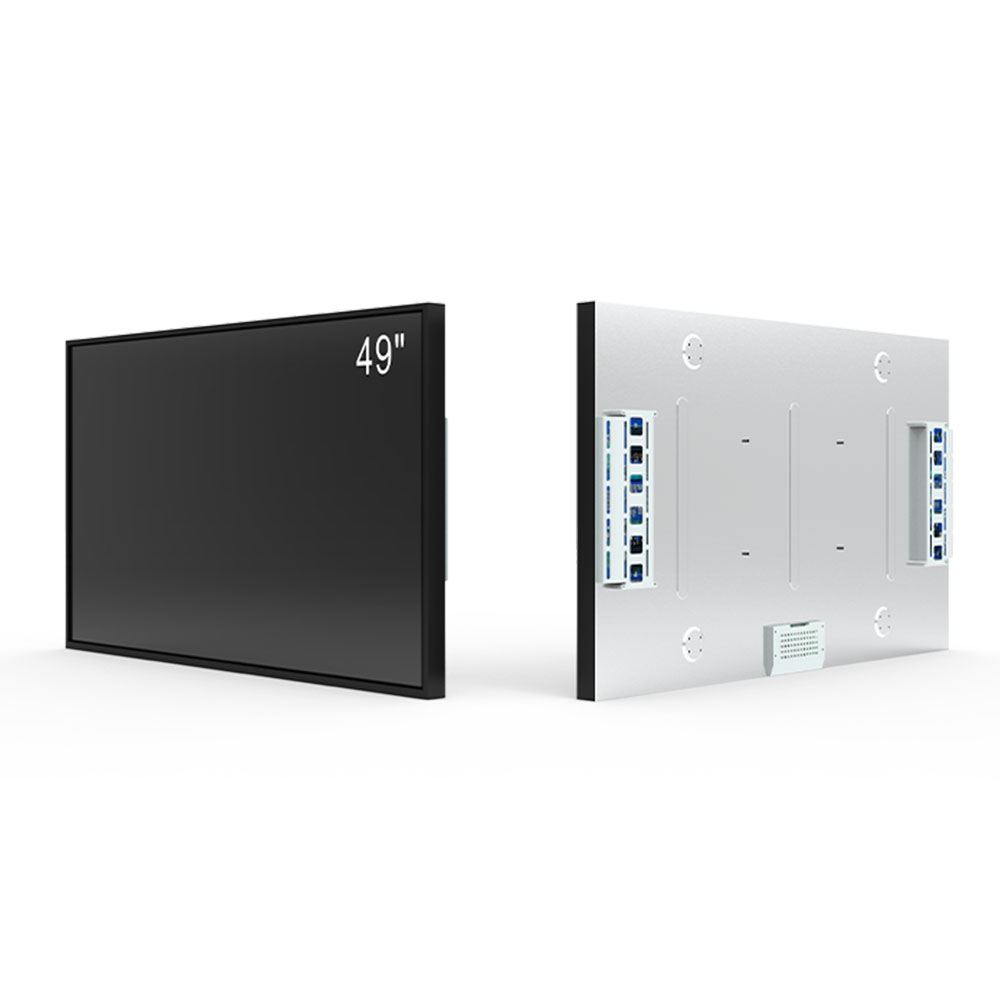
49.5" Stretch Bar Display — 4000 nits, 1920×720 resolution, sunlight readable
For full specifications and additional sizes, browse our Passenger Information Display page, Outdoor Waterproof Digital Signage and Open Frame Display collections.
Q: How bright does an outdoor passenger information display need to be?
A: For open-air locations, we recommend 3000–5000 nits. For sheltered locations, 1500–2500 nits is typically sufficient.
Q: Can your displays operate in extreme heat?
A: Yes. Our displays are rated for -20°C to 70°C operation, with Heat Resistant technology preventing panel blackening.
Q: What connectivity options do your displays support?
A: Ethernet, 4G/LTE, WiFi, and RS485. We work with your network team to ensure compatibility with your existing infrastructure.
Q: What is the expected lifespan?
A: up to 50,000+ hours of backlight life. In practice, many displays keep running well beyond that.
Passenger Information Display — Complete range of transit displays for bus stops, railway platforms, and metro stations
Outdoor Waterproof Digital Signage — Full range of IP65/IP66-rated outdoor displays for transit locations
Sunlight Readable LCD Display — Sunlight-readable displays from 500 to 5000 nits
Open Frame Display — Embedded display solutions for custom transit kiosks
EV Charging Station Display — Touch-enabled displays for transit hub charging stations
Window Facing High Brightness Display — High-brightness displays for transit center retail and advertising spaces
OEM/ODM Custom Solutions — Custom display engineering for specialized applications
Source article: https://www.risinglcd.com/news/passenger-information-display-hardware-selection-guide.html