RisingStar
- Home
- About Us
- Products
- News
- Video
- Contact
- Send Inquiry
Search
- Home
- About Us
- Products
- News
- Video
- Contact
- Send Inquiry
RisingStar
High-brightness sunlight-readable LCD screens have become indispensable in modern outdoor and industrial applications where visibility under direct sunlight is critical. These displays are engineered to deliver exceptional clarity, contrast, and color accuracy even under extreme lighting conditions—such as bright daylight, high ambient temperatures, and harsh environmental factors like dust, moisture, and vibration. According to the International Electrotechnical Commission (IEC) standard IEC 60068-2-1, such displays must maintain operational integrity across a wide temperature range (-20°C to +70°C), making them suitable for use in military, transportation, agriculture, construction, and public information systems.
The core technology behind these screens lies in their ability to produce luminance levels that far exceed those of standard indoor LCDs. While typical consumer-grade displays offer around 300 nits (cd/m²), sunlight-readable LCDs often operate at 3,000 to 5,000 nits or higher—ensuring readability even in full sun (which can reach up to 100,000 lux). This is achieved through advanced backlighting solutions such as LED arrays with high-efficiency drivers, polarized filters optimized for glare reduction, and anti-reflective coatings on the display surface. Some manufacturers, like Innolux and LG Display, integrate micro-lens arrays or diffusers to enhance brightness uniformity while minimizing power consumption—a crucial factor in portable or battery-powered devices.
Another key feature is the use of transmissive liquid crystal cells designed for high contrast ratios (typically above 1000:1). This ensures text and graphics remain sharp and legible against bright backgrounds. Additionally, some models incorporate adaptive brightness control using ambient light sensors that dynamically adjust luminance based on real-time environmental conditions—an energy-efficient strategy validated by studies from the Society for Information Display (SID). For instance, a 2022 SID report showed that adaptive brightness reduces average power consumption by up to 40% without compromising visibility.
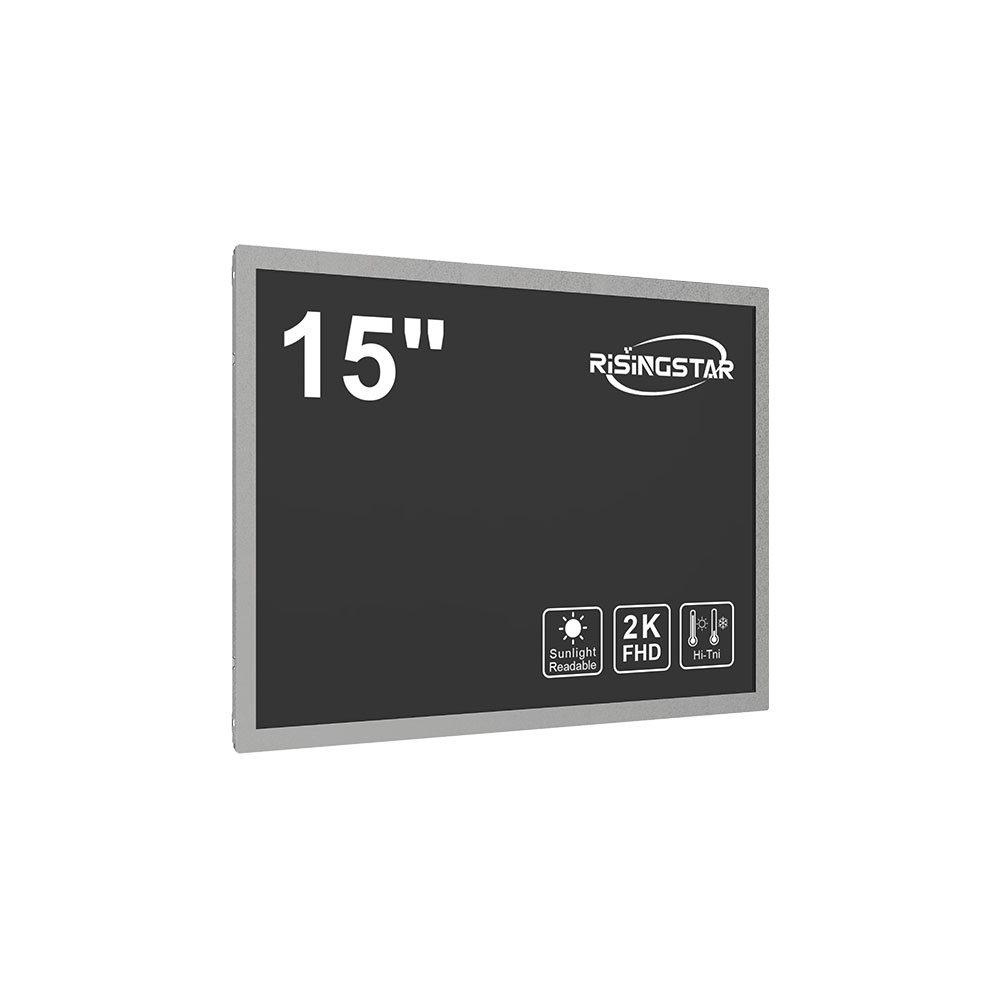
Case studies demonstrate the effectiveness of these technologies. In a deployment by Siemens for railway signaling systems in Southeast Asia, sunlight-readable LCDs were used in outdoor control panels exposed to intense tropical sunlight. The system achieved 99.8% uptime over two years, significantly outperforming legacy CRT-based systems that suffered from screen washout and overheating. Similarly, in the agricultural sector, companies like John Deere have integrated high-brightness displays into tractors for GPS navigation and field mapping—enabling precise operation even during midday farming activities.
To ensure long-term durability, many of these displays meet IP65 or higher ingress protection standards, protecting against water jets, dust, and mechanical shocks. They also comply with MIL-STD-810G for shock and vibration resistance, a requirement commonly mandated in military-grade equipment. OLED-based variants are emerging as a promising alternative due to their self-emissive nature, which eliminates the need for a separate backlight—though current costs and lifetime stability still limit their widespread adoption compared to traditional LCDs.
In conclusion, high-brightness sunlight-readable LCD technology represents a convergence of optical engineering, materials science, and smart power management. As global demand increases for rugged, reliable outdoor displays—from autonomous vehicles to smart city kiosks—this technology will continue to evolve, driven by innovations in quantum dot enhancement, flexible substrates, and AI-driven brightness optimization algorithms.