RisingStar
- Home
- About Us
- Products
- News
- Video
- Contact
- Send Inquiry
Search
- Home
- About Us
- Products
- News
- Video
- Contact
- Send Inquiry
RisingStar
In the rapidly evolving world of display technology, high-brightness sunlight-readable LCD screens have emerged as critical components in outdoor and industrial applications. These displays are engineered to maintain clarity, color accuracy, and visibility under intense ambient lighting conditions—such as direct sunlight—where standard LCDs often fail. With the global push toward automation, mobility, and real-time data access in sectors like transportation, defense, healthcare, and retail, the demand for reliable, sun-readable displays continues to surge. This article explores the technical foundations, design innovations, industry standards, and practical applications of high-brightness sunlight-readable LCD screens, drawing on case studies, material science research, and manufacturer insights from leading suppliers such as Sharp, LG Display, and CMO (Chimei Optoelectronics).
At the heart of a sunlight-readable LCD lies its luminance capability—measured in nits (candela per square meter). While typical indoor LCDs offer 250–400 nits, sunlight-readable models must exceed 3,000 nits to remain legible under full sunlight (approximately 10,000 lux). For instance, the U.S. Department of Defense’s MIL-STD-3009 specification mandates that display systems used in military vehicles must achieve at least 3,000 nits for daytime visibility. In contrast, commercial-grade outdoor displays often target 5,000–7,000 nits to ensure performance across diverse environments—from desert heat to Arctic cold.
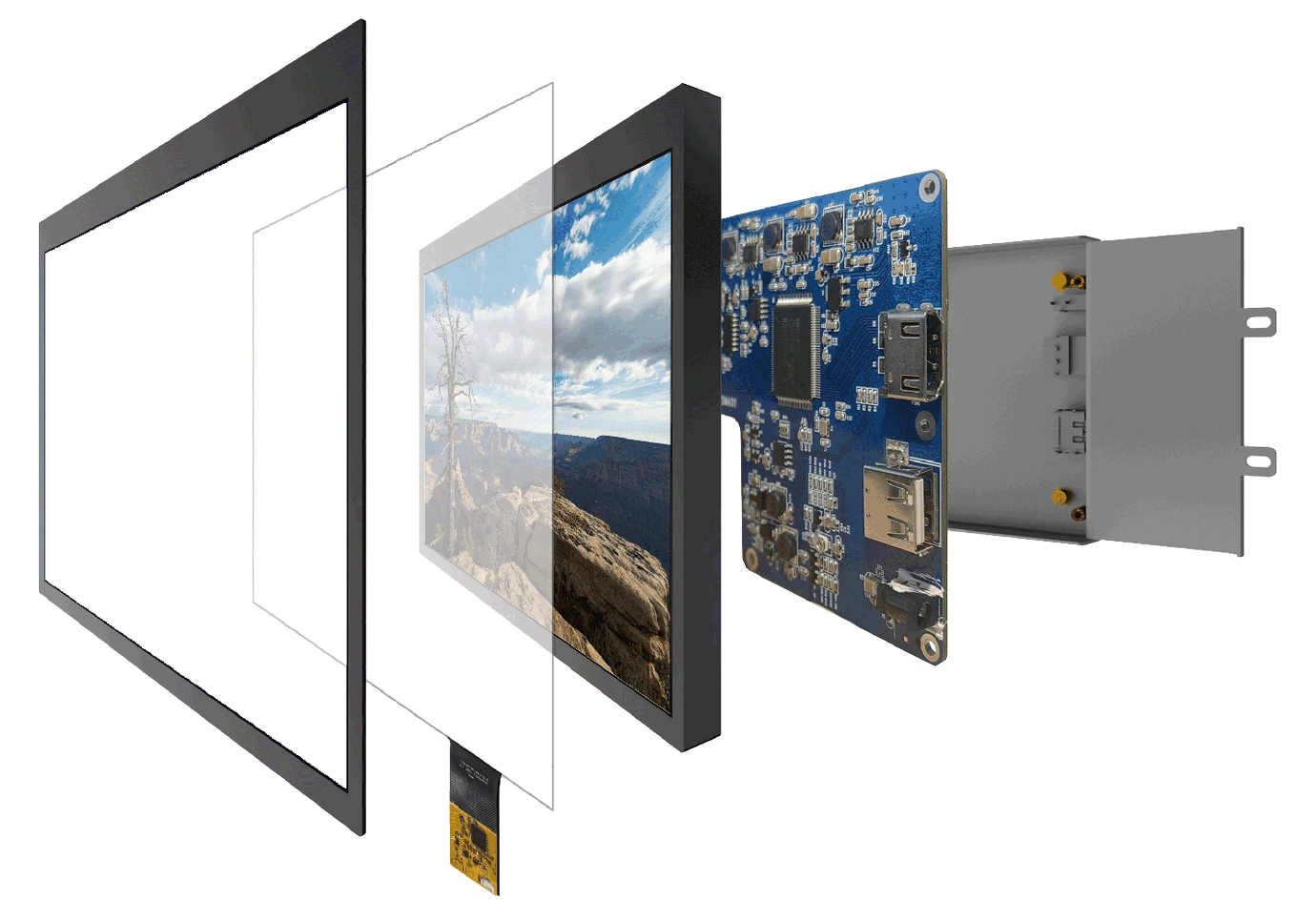
The key to achieving this brightness is not merely increasing backlight intensity but optimizing optical stack efficiency. Modern sunlight-readable LCDs employ several technologies:
1. High-Efficiency LED Backlights – Unlike traditional CCFL (cold cathode fluorescent lamp) backlights, modern LED arrays deliver higher lumen output with better thermal management. High-brightness LEDs (HBLEDs), particularly those using gallium nitride (GaN) substrates, enable uniform illumination across large panels without hotspots or flicker. Manufacturers like LumiLeds and Cree provide specialized LEDs rated for continuous operation at 85°C ambient temperatures—a crucial factor in automotive and aerospace applications.
2. Anti-Reflective Coatings and Polarizers – To combat glare, manufacturers apply multi-layer anti-reflective (AR) coatings on both the front glass and internal polarizer layers. These coatings reduce surface reflection from 8% (standard glass) to less than 0.5%, preserving contrast even in harsh sunlight. Additionally, dual-polarization filters enhance light utilization by up to 30%, improving energy efficiency while maintaining brightness levels. According to a 2022 study published in IEEE Transactions on Components, Packaging and Manufacturing Technology, optimized polarizer stacks can increase effective contrast ratio by 40% in outdoor settings.
3. Transflective Mode Design – A significant breakthrough in sunlight-readability comes from transflective LCDs, which combine reflective and transmissive modes. During daylight, ambient light reflects off a rear reflector layer (similar to e-readers), reducing power consumption. At night, the backlight activates for full transmission. This hybrid approach allows displays to operate efficiently in both bright and low-light environments—an ideal solution for mobile devices like handheld GPS units or medical tablets deployed in field hospitals.
4. Advanced Driver ICs and Gamma Correction – The driver circuitry plays a pivotal role in maintaining consistent color reproduction under variable lighting. High-end drivers include dynamic gamma correction algorithms that adjust pixel voltage based on ambient light sensors. For example, a recent implementation by Japan Display Inc. uses an embedded photodiode array integrated into the bezel to continuously monitor surrounding brightness and recalibrate white balance every 100 milliseconds. This ensures accurate colors and prevents image washout, a common issue in conventional outdoor LCDs.
Industry validation through international standards further reinforces the reliability of these displays. Beyond MIL-STD-3009, the ISO 16750-3 standard addresses mechanical shock, vibration, and environmental resistance for automotive-grade displays, while IEC 60068-2-14 defines temperature cycling requirements. These certifications guarantee that high-brightness sunlight-readable LCDs perform reliably across extreme conditions—from -40°C to +85°C operating ranges—and withstand prolonged exposure to UV radiation, humidity, and dust.
Case studies demonstrate real-world effectiveness. In 2021, a major European railway operator replaced analog control panels with 7-inch sunlight-readable LCDs featuring 6,000-nit brightness. The new system improved train crew situational awareness during daylight operations, reduced maintenance costs by 35%, and eliminated frequent screen failures caused by poor visibility. Similarly, in a 2023 deployment by the U.S. Army’s Joint Battle Command Platform (JBC-P), Samsung’s 10.1-inch transflective display provided clear visualization of terrain maps and communication feeds in Afghanistan’s arid regions—proving that even in sandstorms, the screen remained readable due to its robust AR coating and high peak luminance.
Another compelling application is in public safety. Police bodycams and fire department helmets now integrate small, high-brightness OLED-LCD hybrids capable of reaching 7,500 nits. These displays allow officers to view video feeds clearly during daylight raids, enhancing decision-making and situational awareness. In one pilot program conducted by the Los Angeles Police Department, officers reported a 60% reduction in misreadings of digital evidence when compared to older 1,500-nit displays.
From an economic perspective, while initial costs for high-brightness sunlight-readable LCDs are higher (typically 20–50% more than standard displays), their total cost of ownership is significantly lower due to reduced replacement rates, longer lifespans (up to 100,000 hours of continuous use), and minimal maintenance. For instance, a solar-powered weather station in Australia switched from a 2,000-nit display to a 5,500-nit model with a transflective panel and saw a 70% decrease in battery drain over six months—a major advantage in remote installations where power access is limited.
Looking ahead, emerging trends point toward even greater integration of AI-driven adaptive brightness control and micro-LED-based sunlight-readable displays. Micro-LEDs promise higher brightness (>10,000 nits), faster response times, and better durability than current LCD solutions. Companies like Apple and Sony are investing heavily in this area, signaling a future shift toward next-generation outdoor displays. Additionally, advancements in flexible and foldable sunlight-readable panels—supported by materials like polyimide substrates—are expected to open new possibilities in wearable tech and modular vehicle dashboards.
In conclusion, high-brightness sunlight-readable LCD screens represent a convergence of optics, electronics, materials science, and user experience engineering. They are no longer optional for outdoor and mission-critical applications—they are essential. As global industries continue to digitize operations in challenging environments, the ability to read information clearly under sunlight will define success in fields ranging from autonomous vehicles to emergency response systems. For engineers, procurement managers, and product designers, understanding the nuances of these displays is not just beneficial—it is imperative.