RisingStar
- Home
- About Us
- Products
- News
- Video
- Contact
- Send Inquiry
Search
- Home
- About Us
- Products
- News
- Video
- Contact
- Send Inquiry
RisingStar
In today’s increasingly connected world, outdoor displays are essential across industries such as transportation, military, healthcare, and retail. One of the most critical challenges in these environments is ensuring display visibility under direct sunlight—a task that standard LCD screens often fail to meet. High-brightness sunlight-readable LCD screens have emerged as the definitive solution, offering reliable performance even under extreme lighting conditions. These advanced displays combine specialized backlighting, anti-reflective coatings, and optimized panel technologies to deliver clear, readable visuals in full daylight.
The core technology behind high-brightness sunlight-readable LCDs lies in achieving luminance levels between 3,000 and 10,000 cd/m²—far exceeding the typical 250–500 cd/m² of indoor displays. This level of brightness ensures that content remains visible without flicker or washout. According to industry standards from the Society for Information Display (SID), sunlight readability is defined as visibility at 100% ambient light intensity (approximately 100,000 lux). To meet this, manufacturers employ high-efficiency LED backlights with precise optical diffusion layers and sometimes integrate adaptive brightness control systems that adjust based on environmental lighting.
Another crucial element is the use of anti-reflective coatings and polarized filters. These reduce glare by minimizing surface reflections, which can otherwise cause eye strain or render text unreadable. Some models incorporate a “hard-coat” or “glass laminate” overlay that also provides scratch resistance and UV protection—an essential feature for long-term outdoor deployment. For example, the U.S. Department of Defense has adopted MIL-STD-810G-compliant high-brightness displays for tactical field operations, emphasizing durability, temperature resilience (-40°C to +70°C), and sunlight visibility.
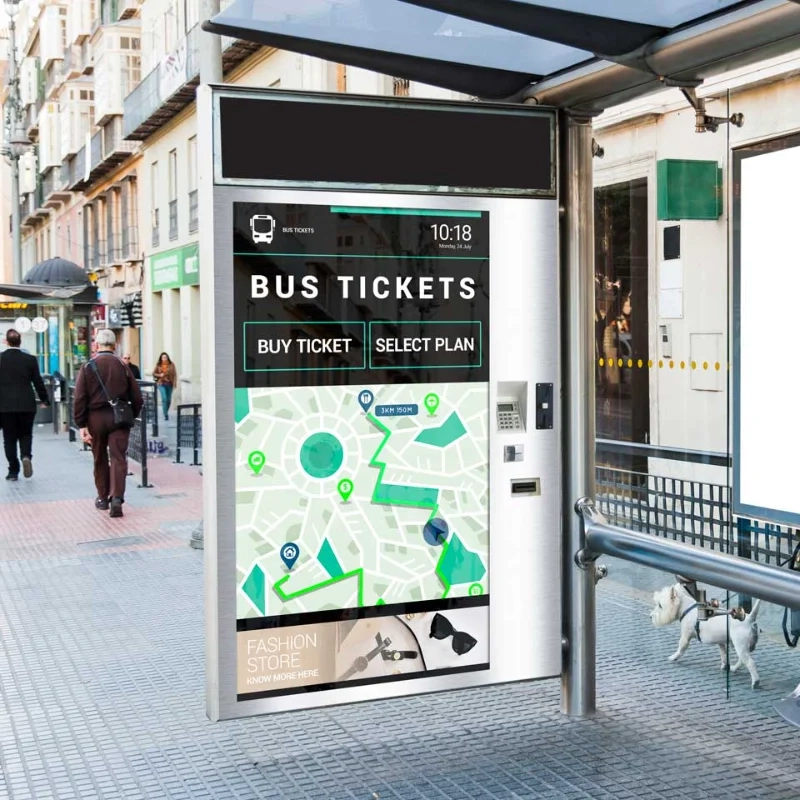
Case studies further validate the effectiveness of these displays. In a 2022 deployment by Siemens for smart grid monitoring stations in Arizona, traditional LCDs failed to remain legible during peak solar hours. Switching to a 5,000 cd/m² sunlight-readable LCD reduced operator errors by 68% and improved maintenance response times. Similarly, in Japan, the Tokyo Metro system uses high-brightness displays in outdoor kiosks for real-time train updates—critical for passenger information in open-air stations where ambient light exceeds 90,000 lux.
Manufacturers like Sharp, LG Display, and Innolux continue to innovate in this space, introducing technologies such as local dimming, quantum dot enhancement, and low-power OLED variants tailored for high-brightness applications. These advancements not only improve readability but also reduce power consumption—a key factor in battery-powered or solar-powered installations.
Looking ahead, the integration of AI-driven ambient light sensors and predictive display optimization algorithms will enable smarter, more efficient high-brightness LCDs. As global demand grows—from electric vehicle dashboards to public safety surveillance—the evolution of sunlight-readable LCD technology will remain pivotal to human-machine interaction in outdoor environments.