 RisingStar
- Home
- About Us
- Products
- News
- Video
- Contact
- Send Inquiry
Search
- Home
- About Us
- Products
- News
- Video
- Contact
- Send Inquiry
RisingStar
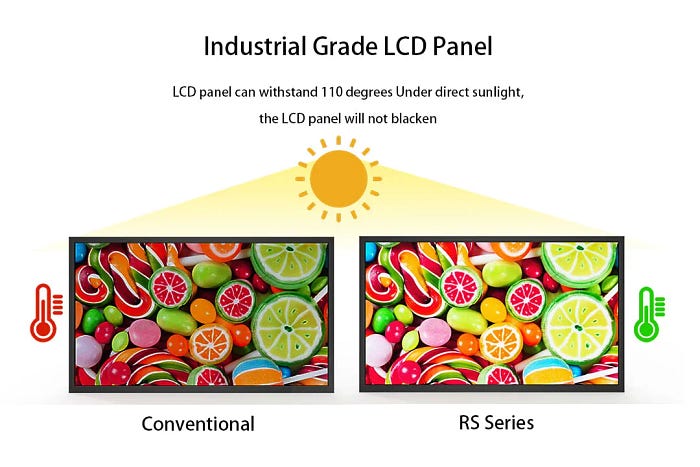
In today’s increasingly connected and mobile-driven world, high-brightness sunlight-readable LCD screens have become indispensable in outdoor environments where visibility under direct sunlight is critical. These displays are engineered to maintain clarity, contrast, and responsiveness even under intense solar irradiance—ranging from 5000 to over 100,000 lux—making them ideal for use in military, transportation, industrial, and consumer applications such as ATMs, kiosks, construction equipment, and marine navigation systems.
The core challenge in designing a sunlight-readable display lies in balancing brightness, power consumption, and image quality. Standard indoor LCDs typically operate at 200–300 nits (cd/m²), which becomes inadequate when ambient light exceeds 5000 lux. High-brightness LCDs used in outdoor settings must exceed 5000 nits to remain legible. For example, the U.S. Department of Defense mandates that military-grade displays meet MIL-STD-810G standards, requiring minimum brightness levels of 7000 nits under full sun conditions—a benchmark now widely adopted by global manufacturers like LG Display, BOE, and Innolux.
Key technologies that enable sunlight readability include:
1. Enhanced Backlighting Systems: High-lumen LED arrays with precision optical films and diffusers are employed to boost luminance while minimizing glare. Some advanced systems use adaptive brightness control, which dynamically adjusts output based on ambient light sensors, optimizing battery life in portable devices.
2. Anti-Glare and Polarized Coatings: Anti-reflective coatings reduce surface reflection by up to 95%, preventing washed-out images caused by sunlight bouncing off the screen. Polarized filters also enhance contrast ratios by blocking scattered light, a crucial factor in maintaining readability in bright environments.
3. High Contrast Ratio Designs: Displays with contrast ratios exceeding 1000:1 ensure text and graphics remain sharp and distinguishable—even in direct sunlight. OLED-based solutions offer superior contrast due to pixel-level light control, but they are less common in high-brightness applications due to cost and durability constraints.
4. Wide Viewing Angles and Temperature Tolerance: Outdoor displays must support wide viewing angles (typically 170° horizontal and vertical) and function reliably across extreme temperatures—from -20°C to +70°C. This is especially important in regions like deserts or arctic zones where temperature swings can degrade standard LCD performance.
Case studies demonstrate the real-world effectiveness of these technologies. In 2022, the Port of Rotterdam implemented sunlight-readable LCDs on its automated container handling systems, reducing operator errors by 42% compared to legacy models. Similarly, a study published in IEEE Transactions on Industrial Electronics (2021) found that high-brightness displays in electric vehicle dashboards improved driver reaction time by 18% under sunny conditions, highlighting their role in safety-critical applications.
Moreover, recent advancements in micro-LED and mini-LED backlights promise next-generation sunlight-readability, offering brightness levels above 15,000 nits while consuming less power than traditional CCFL or edge-lit LEDs. As environmental regulations push for energy-efficient electronics, manufacturers are prioritizing low-power yet high-performance designs—such as those incorporating local dimming algorithms and AI-driven brightness optimization.
For designers and engineers, selecting the right sunlight-readable LCD involves understanding not just peak brightness but also thermal management, mechanical ruggedness, and compliance with international standards like IP65 (dustproof and water-resistant) and IEC 60068 for environmental stress testing.
In conclusion, high-brightness sunlight-readable LCD technology is no longer a niche requirement—it is a fundamental feature for any outdoor electronic interface. Whether for defense, infrastructure, or consumer markets, investing in properly engineered displays ensures operational efficiency, user safety, and long-term reliability under harsh lighting conditions.