RisingStar
- Home
- About Us
- Products
- News
- Video
- Contact
- Send Inquiry
Search
- Home
- About Us
- Products
- News
- Video
- Contact
- Send Inquiry
RisingStar
A bus shelter information strip in London. A metro platform edge display in Tokyo. A gas pump advertising panel on a highway in Texas. These installations share one constraint: the display must fit a cutout that's wide but not tall — 1200mm across, 180mm high. A standard 16:9 panel is the wrong shape.
Quick Answers
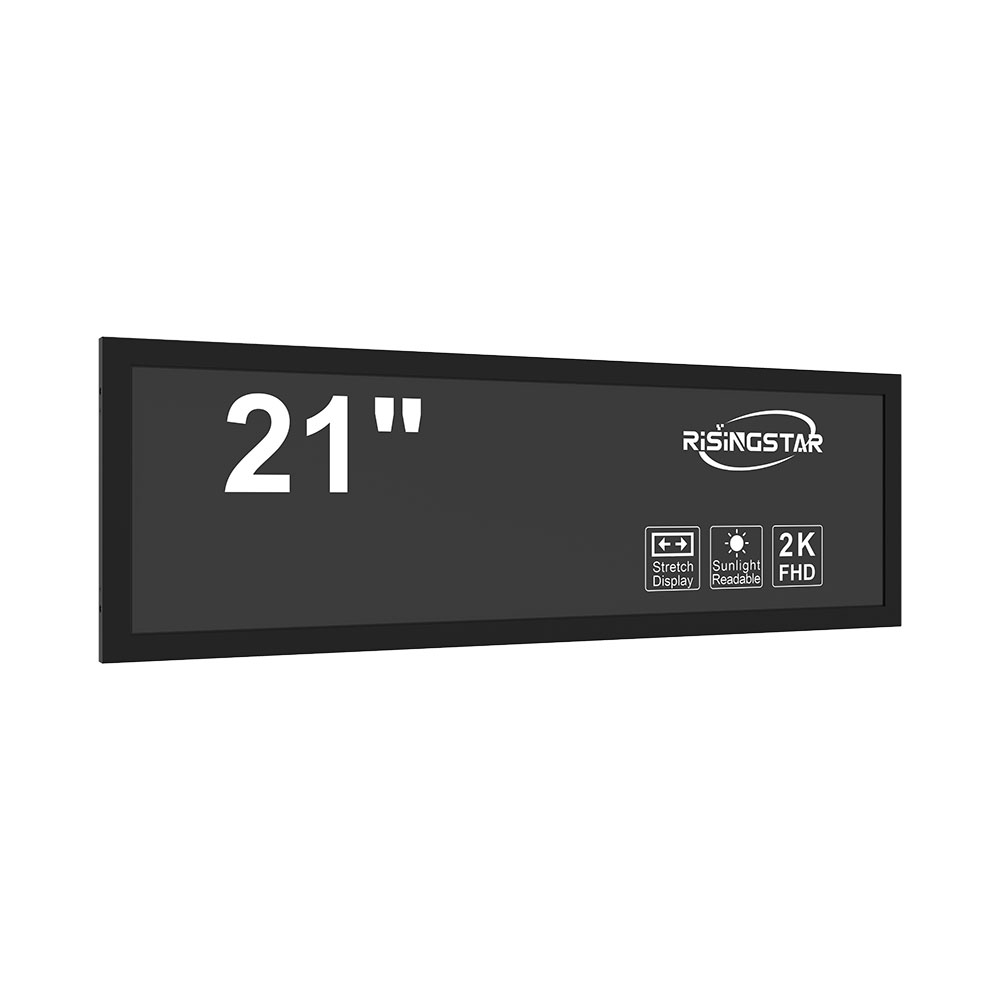
What is a stretch bar display? An ultra-wide format open frame monitor with aspect ratios significantly wider than standard 16:9 — typically 32:3, 16:4.5, or fully custom resolutions such as 3840×360 or 1920×720 — engineered for narrow mounting spaces like bus shelter information strips, metro platform edge displays, shelf-edge retail signage, and onboard transit ceiling panels.
Why not use a standard 16:9 panel and crop it? Cropping a 16:9 panel wastes 60–80% of the backlight power on areas masked by bezels, creates uneven thermal distribution, and leaves unused LCD cell area that degrades reliability. A native stretch bar panel uses the entire cell, backlight, and driver for the active area — lower power, better thermal balance, and a thinner overall chassis depth (typically 25–35mm).
Who needs stretch bar displays? System integrators building transit passenger information displays (PIDS), gas pump advertising strips, shelf-edge electronic labels, digital menu boards in space-constrained fast-food kitchens, and any custom kiosk where width exceeds height in a ratio beyond standard formats.
Standard LCD panels are cut from Gen 6, Gen 8, or Gen 10.5 motherglass in fixed aspect ratios — 16:9, 16:10, 4:3. For a transit information display that must fit into a 1200mm × 180mm cutout on a bus shelter, a 16:9 panel is the wrong shape. The integrator faces three unsatisfactory options:
Use a standard panel and mask the excess area — the panel extends beyond the cutout, requiring the enclosure to bulge around unused screen area. Wasted backlight power heats the enclosure with no benefit.
Accept a smaller standard panel — a 7" or 10.1" screen in a narrow space, leaving the surrounding area as dead space that the passenger ignores.
Spec a native stretch bar panel — a custom-width LCD cell that matches the enclosure dimensions exactly. At the motherglass mask design stage, the panel is laid out as a native ultra-wide strip rather than being cut from a standard-ratio cell. Every pixel is visible, every LED contributes to the useable image, and the chassis fits flush without bulge.
A stretch bar display solves this by using a custom LCD cell designed with a native ultra-wide aspect ratio during photolithography — before panel assembly. Unlike resized (cut) panels that physically slice and reseal a standard 16:9 open cell, native stretch bar panels avoid edge seal degradation, maintain uniform LC cell gap across the full width, and produce no wasted backlight area. The result is a display module with an aspect ratio that can reach 32:3 or wider, in diagonal sizes from approximately 24" to 88".
RisingStar manufactures stretch bar outdoor open frame monitors & displays alongside standard-format open frame modules. For integrators working with more conventional aspect ratios, the 21.5 inch open frame display series provides a more familiar form factor while maintaining the same integration flexibility, optical bonding, and Hi-Tni panel options.
| Parameter | Native Stretch Bar Display | Cropped 16:9 Panel |
|---|---|---|
| Active Area Utilization | 100% — every pixel is in the visible window | 20–40% — 60–80% of the panel masked by bezel |
| Backlight Efficiency | Full LED array targets the active area only | Most LED output blocked by bezel mask; heat still conducts into the chassis |
| Chassis Depth | 25–35mm (optimized for the active area) | 40–60mm (accommodates unused panel extension) |
| Thermal Profile | Uniform across the active area | Hot spots at the masked panel edge where heat cannot dissipate through the enclosure |
| Native Resolution | Custom (e.g., 3840×360, 1920×720, 1536×256) | Standard (1920×1080) — cropped and scaled |
| Driver Board | Custom firmware for non-standard timing | Standard driver with partial panel drive |
| Cost per mm² of Active Area | Higher upfront NRE, lower per-unit at volume | Lower NRE, higher per-unit in power loss and chassis cost |
The thermal argument is the one most frequently underestimated by first-time integrators. A 3000-nit backlight pushing 60W of LED power does not stop consuming 60W just because 70% of the panel is covered by a bezel. The LEDs still dissipate that heat into the chassis, and the chassis still needs to reject it through the enclosure. Meanwhile the visible portion is only receiving 18W of optical output. A native stretch bar panel with a precisely sized backlight can deliver the same 3000 nits to the visible area at 18W of LED power — a 70% reduction in thermal load that directly extends backlight life and simplifies enclosure cooling.
The single largest deployment category for stretch bar displays. Bus shelters, metro platforms, and airport transit corridors use narrow horizontal cutouts to display real-time arrival information, route maps, and service alerts. A typical installation at a bus shelter uses a 48" stretch bar with a resolution around 3840×360 pixels — wide enough to show 4–6 bus routes simultaneously in an information strip just 90mm tall.
The mechanical constraints are demanding: the display must fit within the shelter's extruded aluminum framing, operate in semi-outdoor conditions with direct sun exposure through the shelter glass, and maintain readability at a 2–5m viewing distance. These installations typically require:
1500–3000 nits calibrated brightness to overcome shelter glass reflections
Optical bonding to prevent internal condensation between the cover glass and LCD — temperature swings inside a shelter can exceed 20°C within an hour
-20°C to 70°C operating range for year-round deployment
IP65 front sealing integrated into the shelter enclosure
For metro platform edge displays, the stretch bar format allows information to be mounted directly above the platform edge doors, where vertical space is limited to 150–200mm but horizontal runs extend 2000mm+. These displays use an even wider format — often custom aspect ratios exceeding 10:1 — with higher brightness (2500–4000 nits) to compete with underground station lighting and occasional direct sun at entrance zones.
Fuel dispenser panels incorporate a horizontal advertising strip above the payment keypad. The usable display window on a typical dispenser is approximately 400mm × 100mm — a 4:1 aspect ratio. Stretch bar displays in the 24"–36" range fit this cutout precisely, eliminating the bezel gaps that collect fuel residue and cleaning chemicals.
The engineering challenge here is chemical resistance: the display must survive daily exposure to gasoline vapors, diesel splash, and aggressive cleaning agents. RisingStar's stretch bar configurations for gas pump applications use UV-resistant tempered glass with oleophobic coating and conformally coated driver boards to prevent corrosion.
Retail shelf-edge displays require ultra-slim (<15mm) modules that can mount directly on shelving rails. Small-format stretch bars (24"–32") with 500–1000 nits replace paper labels with dynamic pricing and promotional content. The key mechanical requirement is the low profile — the driver board must be integrated into the chassis depth or mounted remotely via a ribbon cable extender.
Any kiosk with a landscape-dominant UI — menu boards, wayfinding maps, interactive timelines — can benefit from a stretch bar format that eliminates wasted bezel space. The custom aspect ratio allows the integrator to match the display exactly to the UI canvas, removing the need for software letterboxing or hardware masking.
Mounting a stretch bar display follows the same principles as standard open frame integration, but the extreme aspect ratio introduces unique considerations.
A 48" display that is only 90mm tall has a slender chassis that can flex under its own weight if not properly supported. The chassis must include stiffening ribs or a C-channel profile along the long axis to maintain flatness. For installations in transit vehicles where vibration is continuous, the mounting points should be distributed along the full length rather than relying on corner mounts only.
RisingStar's stretch bar chassis designs use extruded aluminum backplates with integrated stiffening webs. Mounting points are spaced at 200–300mm intervals along the rear surface, with threaded inserts accepting M4 fasteners. For high-vibration transit installations, locking connectors (latching Molex or screw-lock D-Sub) and cable strain relief brackets are specified by default.
In a standard 16:9 panel, the LED backlight array is roughly square, and heat spreads radially from the center. In a stretch bar, the LED array is a long narrow strip. Heat must be conducted along the chassis length to the ends, where it can be rejected. Without proper thermal design, the center of the display runs significantly hotter than the edges.
The solution combines two approaches:
Aluminum alloy backplate with high thermal conductivity (typically 140–160 W/m·K for 6061-grade alloy used in display chassis) acts as a lateral heat spreader
Multiple NTC thermistors placed at 3–5 points along the LED strip feed temperature data to the driver board, which applies local dimming adjustments to balance temperature across the array
Large-format cover glass with extreme aspect ratios is more susceptible to warping and breakage during lamination. The glass thickness must be selected based on the long dimension:
| Display Diagonal | Long Edge | Recommended Glass Thickness | IK Rating Target |
|---|---|---|---|
| 24" bar (4:1) | ~600mm | 3mm chemically strengthened | IK08 |
| 48" bar (10:1) | ~1200mm | 4mm chemically strengthened | IK08 |
| 88" bar (32:3) | ~2000mm | 5mm laminated or heat-strengthened | IK07 |
For transit applications above 1000mm length, heat-strengthened or fully tempered glass is recommended over chemically strengthened glass, because the thermal expansion stress across the long axis during summer sun exposure can exceed the compressive stress layer depth of chemical strengthening.
Stretch bar displays require custom timing controller (TCON) firmware to handle non-standard resolutions and pixel clocks. A 3840×360 panel at 60 Hz requires a pixel clock of approximately 90–95 MHz including standard CVT-RB (Coordinated Video Timing – Reduced Blanking) overhead — the horizontal and vertical blanking intervals that every video signal carries beyond the active pixel area. Without accounting for blanking, the bare active pixel rate alone (~83 MHz) is insufficient for stable frame timing. RisingStar provides driver board firmware pre-configured per resolution, with HDMI and DisplayPort inputs that accept standard graphics card output scaled to the native resolution.
Color uniformity across the width of a stretch bar panel is more challenging than in a standard format because the viewing angle varies significantly from the center to the far edges. At a 2m viewing distance for a 48" bar, the edge viewing angle exceeds 60° off-axis. IPS or AHVA panels with 178° rated viewing angles maintain acceptable color shift within ±30°, but cost-sensitive projects using TN panels may show detectable brightness and color variation at the edges. For this reason, RisingStar specifies IPS-grade panels across its entire stretch bar product line.
The decision to use a native stretch bar display rather than adapting a standard panel comes down to three factors that compound at production scale:
Enclosure simplification. The host enclosure does not need to accommodate excess panel area. For a shelter manufacturer deploying 500 transit displays, the enclosure tooling cost savings alone can offset the stretch bar NRE.
Thermal reliability at high brightness. Eliminating masked panel area reduces backlight power by 50–70% for the same visible brightness. At volume, this directly reduces field failure rates from LED overtemp degradation.
Aesthetic and brand control. The display fills the cutout exactly. No dead space, no masking bezels, no "screen in a box" appearance. For customer-facing transit information systems and retail signage, the visual quality difference is immediately apparent.
RisingStar's stretch bar open frame displays are manufactured in a 4,000㎡ ISO 9001-certified facility with Class 10,000 cleanroom assembly — the same optical bonding and quality control processes used across the full product range. Panel sourcing through direct partnerships with LG Display, AUO, Innolux, BOE, and Tianma ensures Grade A/A+ cell quality and long-term supply consistency. Each unit undergoes a 72-hour high-temperature burn-in at 50°C and full AOI pixel scanning before shipment.
Q1: What is the difference between a native stretch bar display and a cut (resized) panel?
A native stretch bar display is designed at the motherglass mask design stage — the panel layout on the glass substrate is inherently ultra-wide, using a dedicated photomask during photolithography. No physical slicing occurs. A cut (resized) panel starts as a standard 16:9 open cell, which is then laser-cut to the desired width and resealed with edge reconstruction and LC resealing. Native panels avoid edge seal degradation and maintain uniform cell gap across the full width, while cut panels introduce a potential failure mode at the resealed edge under thermal cycling.
Q2: What aspect ratios are available for stretch bar displays?
Common aspect ratios include 32:3, 16:4.5, and 10:1, with diagonal sizes from approximately 24" to 88". Native resolutions are custom — typical examples include 3840×360 for transit PIDS, 1920×720 for shelf-edge retail, and 1536×256 for ultra-narrow information strips. Custom resolutions are configurable per project.
Q3: Why is thermal management more challenging in a stretch bar than a standard 16:9 panel?
In a standard panel, heat from the LED backlight spreads radially from a roughly square array. In a stretch bar, the LED array is a long narrow strip. Heat must travel laterally along the chassis to reach the edges where it can be rejected — the center of a 48" bar can run significantly hotter than the ends without proper thermal design. The solution uses an aluminum alloy backplate (typically 140–160 W/m·K for 6061-grade) as a lateral heat spreader, plus multiple NTC thermistors at 3–5 points along the LED strip for local dimming compensation.
Q4: What brightness level does a stretch bar display need for outdoor transit applications?
For bus shelters and covered transit platforms with indirect sun through shelter glass, 1,500–2,500 nits is standard. For metro platform edge displays exposed to station lighting and occasional direct sun at entrance zones, 2,500–4,000 nits is typical. Optical bonding is strongly recommended for all outdoor transit installations — it eliminates the internal air gap where condensation forms during day-night temperature cycling inside semi-outdoor shelters.
Q5: Can stretch bar displays support touch interaction?
Yes, PCAP (Projected Capacitive) touch can be integrated on stretch bar displays, though the ultra-wide aspect ratio requires custom touch sensor design and controller tuning. The touch sensor must be manufactured to the same custom dimensions as the LCD cell, and the controller firmware must handle the non-standard touch area mapping. RisingStar provides integrated stretch bar touch solutions as an OEM/ODM option.
Source article: https://www.risinglcd.com/news/stretch-bar-displays-why-ultra-wide-open-frame-monitors-beat-cropped-169-panels.html