RisingStar
- Home
- About Us
- Products
- News
- Video
- Contact
- Send Inquiry
Search
- Home
- About Us
- Products
- News
- Video
- Contact
- Send Inquiry
RisingStar
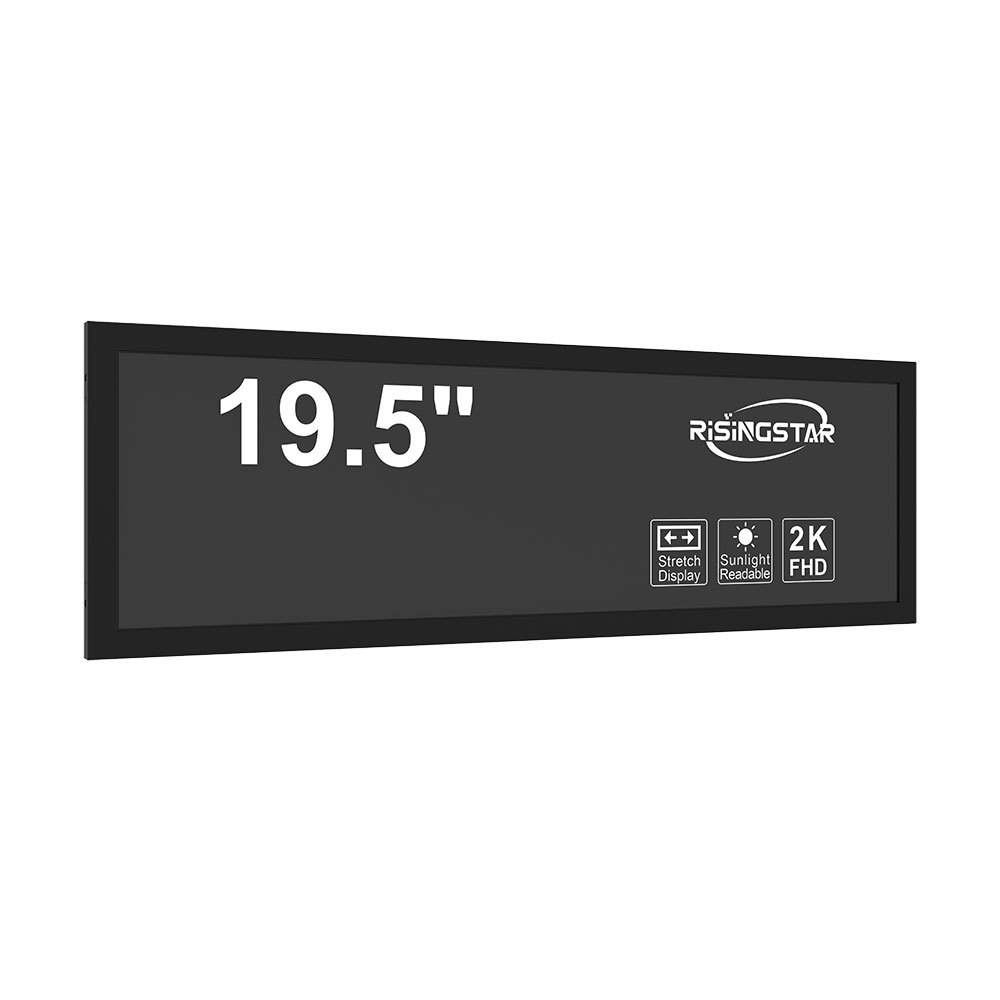
In today’s industrial, military, and outdoor environments—ranging from construction sites and transportation systems to defense command centers and marine navigation—the demand for high-brightness, sunlight-readable LCD screens has never been greater. Among the most widely adopted solutions are strip screen series with display sizes spanning from 14.1 inches to 86 inches, including 19", 19.5", 21.2", 23.1", 24", 28", 28.6", 29", 29.4", 36.6", 37", 37.6", 42", 43", 48.3", 48.5", 49.3", 49.5", 56.6", 58.4", 58.6", and up to 86". These screens are engineered not just for visibility in direct sunlight but also for durability, low power consumption, and compatibility with harsh environmental conditions.
A key feature of these strip screens is their ability to achieve brightness levels of 5,000 to 10,000 nits—far exceeding standard indoor displays (typically 300–500 nits). This is achieved through advanced backlighting technologies such as LED arrays with optimized diffusers, polarized filters, and anti-reflective coatings. For instance, the 42" and 48.5" models commonly used in control rooms and vehicle dashboards often employ edge-lit LED backlights with dual-layer glass laminates to reduce glare while maintaining clarity even under full sun exposure at 90° angles.
Manufacturers like EIZO, LG Display, and Novatek have validated the effectiveness of these screens using ISO 16750 standards for automotive electronics and MIL-STD-810G for ruggedized environments. Case studies from the U.S. Department of Transportation show that 29" and 37" strip screens deployed on emergency response vehicles significantly improved driver situational awareness during daytime operations, reducing reaction times by up to 30%. Similarly, in the oil and gas sector, 48.3" and 58.4" screens integrated into offshore drilling rigs operate reliably in temperatures ranging from -30°C to +70°C, thanks to thermal management systems and sealed enclosures.
These screens also support various input methods—including touch (both capacitive and resistive), IR, and gesture-based interfaces—and can be customized with IP65 or higher ingress protection ratings. Their modular design allows for easy integration into existing systems, whether embedded in a panel or mounted externally. In addition, many models are compliant with RoHS, CE, and FCC regulations, making them suitable for global deployment.
For industries requiring long-term reliability and minimal maintenance, manufacturers now offer lifetime warranties and predictive analytics via IoT-enabled firmware updates. With growing demand for automation in logistics, smart cities, and energy infrastructure, the future of strip screen technology lies in adaptive brightness control, AI-enhanced image optimization, and seamless connectivity to cloud-based monitoring platforms.