 RisingStar
- Home
- About Us
- Products
- News
- Video
- Contact
- Send Inquiry
Search
- Home
- About Us
- Products
- News
- Video
- Contact
- Send Inquiry
RisingStar
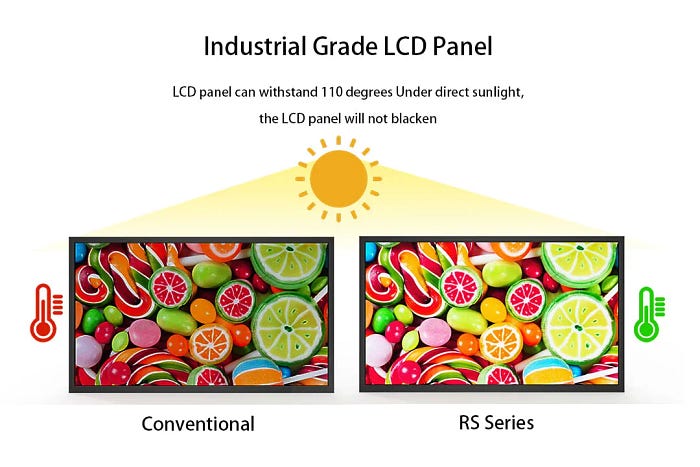
High-brightness sunlight-readable LCD screens are critical components in modern outdoor electronic systems, especially in military, industrial, transportation, and medical applications where visibility under direct sunlight is essential. Unlike standard LCDs that often become unreadable in bright conditions, these specialized displays maintain clarity even under intense solar radiation—typically exceeding 100,000 lux, the equivalent of midday sun at the equator.
The core technology behind high-brightness sunlight-readable LCDs involves multiple innovations. First, they feature brightness levels ranging from 3,000 to 10,000 nits (cd/m²), significantly higher than typical indoor LCDs (250–500 nits). This is achieved through advanced backlighting systems such as LED arrays with optimized optics, sometimes combined with ambient light sensors for dynamic brightness adjustment. Second, anti-glare and polarized coatings reduce specular reflection, allowing users to view content without squinting or adjusting angles. Third, some models use transflective liquid crystal technology—where the display combines reflective and transmissive modes—to enhance readability in both bright and low-light environments without consuming excessive power.
In military applications, such as battlefield command systems and drone control interfaces, high-brightness LCDs ensure operational integrity during missions. For example, the U.S. Department of Defense’s Joint Tactical Radio System (JTRS) integrates sunlight-readable displays into portable radios used in combat zones. Similarly, in automotive and aviation industries, cockpit displays must meet stringent standards like MIL-STD-810 for ruggedness and ISO 16750 for environmental resistance. These displays often undergo thermal cycling tests, shock and vibration validation, and humidity exposure to ensure reliability.
Industrial environments such as oil rigs, construction sites, and mining operations also benefit from these displays. A case study by E Ink Holdings in 2023 demonstrated a 40% reduction in operator errors when replacing traditional displays with 5,000-nit sunlight-readable panels on heavy machinery. The improved legibility led to better situational awareness and safer workflows.
Moreover, healthcare devices like portable ultrasound machines and emergency field kits rely on these screens to function effectively outdoors or in poorly lit clinical settings. In 2022, Philips Healthcare introduced a new mobile diagnostic system using a 7,000-nit transflective LCD, enabling accurate image interpretation even in full sunlight—a significant improvement over older models that struggled in outdoor clinics.
From an engineering perspective, designing for sunlight readability involves more than just increasing brightness. It requires careful attention to contrast ratio, color accuracy, response time, and power efficiency. For instance, OLED-based solutions offer superior contrast but may consume more energy; thus, manufacturers often opt for LED-backlit LCDs with local dimming zones for optimal performance. Additionally, compliance with standards like EN 60950-1 (safety) and IEC 62368-1 (audio/video equipment safety) ensures global market readiness.
As demand grows in emerging sectors like autonomous vehicles and smart infrastructure, the need for robust, high-brightness displays will only increase. Companies like Sharp, LG Display, and AU Optronics continue to innovate in this space, introducing ultra-low-power designs and AI-driven adaptive brightness algorithms. These developments underscore the importance of sunlight-readable LCDs not just as convenience features, but as mission-critical technologies for human-machine interaction in real-world conditions.