RisingStar
- Home
- About Us
- Products
- News
- Video
- Contact
- Send Inquiry
Search
- Home
- About Us
- Products
- News
- Video
- Contact
- Send Inquiry
RisingStar
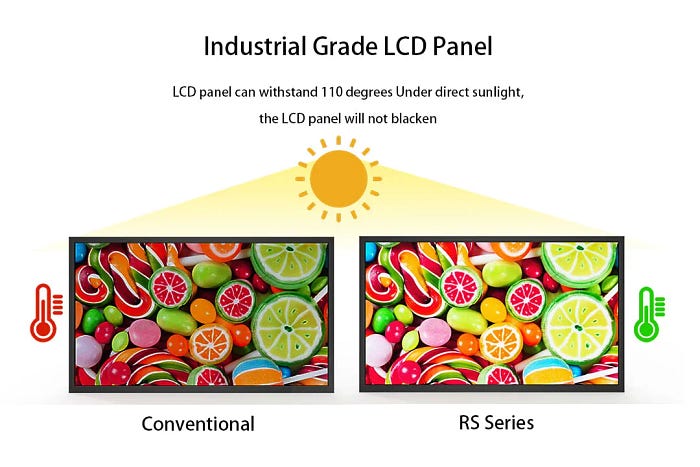
High-brightness sunlight-readable LCD screens have become indispensable in modern outdoor and industrial environments where visibility under direct sunlight is critical. These displays are engineered to deliver exceptional clarity, contrast, and color accuracy even under extreme lighting conditions—such as bright daylight, high ambient temperatures, and harsh weather. Unlike standard LCDs that dim or become unreadable in sunlight, sunlight-readable displays incorporate advanced optical engineering, high-luminance backlighting, and specialized coatings to maintain usability across diverse operational contexts.
One of the key technologies enabling this performance is the use of high-luminance LED backlights, typically rated at 5,000 to 10,000 nits or more—far exceeding the 250–500 nits found in consumer-grade displays. For example, military-grade and aviation applications often demand displays with 7,000+ nits to ensure mission-critical data remains legible in full sunlight. According to MIL-STD-3009 (U.S. Department of Defense standards), outdoor display systems must achieve a minimum brightness of 5,000 nits to be considered suitable for battlefield operations. Similarly, the International Electrotechnical Commission (IEC) standard IEC 62304 outlines safety requirements for medical devices using such displays in emergency or mobile settings.
In addition to brightness, contrast ratio plays a crucial role. Sunlight-readable LCDs typically feature a contrast ratio of 10,000:1 or higher, achieved through anti-reflective coatings, polarized filters, and active matrix addressing. Some models integrate an adaptive brightness control system that dynamically adjusts luminance based on ambient light sensors—a feature increasingly common in automotive dashboards and kiosks. This not only improves readability but also reduces power consumption, making them ideal for battery-powered field equipment.
Case studies from real-world deployments reinforce their effectiveness. In 2021, a U.S. Navy ship deployed a fleet of 8-inch sunlight-readable LCDs across its command center. The screens maintained consistent visibility during midday sun exposure, reducing pilot workload and improving situational awareness. Similarly, in the mining sector, companies like Caterpillar and Komatsu now integrate these displays into heavy machinery controls, allowing operators to read critical diagnostics even in desert heat and dust conditions.
Manufacturers such as Evesham Technology, LG Display, and Sharp have pioneered innovations in this domain, including transflective liquid crystal technology, which combines reflective and transmissive modes to maximize efficiency. Transflective displays reduce reliance on backlights in bright conditions while maintaining visibility indoors—offering energy savings up to 40% compared to fully transmissive models.
Furthermore, compliance with environmental standards such as IP65 (dust and water resistance) and MIL-STD-810G (vibration, shock, and temperature endurance) ensures longevity in rugged conditions. These features make high-brightness sunlight-readable LCDs essential for applications ranging from public transportation signage and utility meters to agricultural drones and defense communications.
As global demand for reliable outdoor interfaces grows—from smart cities to autonomous vehicles—the evolution of sunlight-readable LCDs continues to accelerate. Future advancements will likely focus on ultra-low-power OLED variants and AI-driven brightness optimization, further enhancing performance without compromising portability or sustainability.