RisingStar
- Home
- About Us
- Products
- News
- Video
- Contact
- Send Inquiry
Search
- Home
- About Us
- Products
- News
- Video
- Contact
- Send Inquiry
RisingStar
In today’s increasingly connected and mobile-driven world, the demand for reliable outdoor display technology has surged—especially in industries such as transportation, defense, industrial automation, agriculture, and public information systems. High-brightness sunlight-readable LCD displays have emerged as a critical solution to ensure visibility under harsh environmental conditions, particularly direct sunlight exposure. These specialized screens are engineered not only to withstand extreme brightness but also to maintain clarity, color accuracy, and operational stability in environments where standard LCDs fail completely.
The core challenge in outdoor display design lies in overcoming ambient light interference. According to the Society for Information Display (SID), typical indoor lighting ranges from 300 to 500 lux, while direct sunlight can reach up to 100,000 lux—a difference of over 200 times. Standard LCDs designed for indoor use often fall short when exposed to this level of illumination, resulting in washed-out images, poor contrast, and user frustration. High-brightness sunlight-readable LCDs address this by incorporating advanced optical and electrical engineering techniques that enhance both luminance and contrast ratio, ensuring legibility even in full daylight.
One of the most critical components of these displays is their backlight system. Traditional LED backlights used in consumer-grade displays may offer up to 300–500 cd/m² (candelas per square meter) of brightness, which is insufficient for outdoor use. In contrast, high-brightness sunlight-readable LCDs typically feature active matrix LED backlights capable of producing 3,000 to 10,000 cd/m² or more. This dramatic increase in luminance is achieved through high-efficiency LEDs, optimized driver circuits, and sometimes dual-layer backlight structures. For example, some military-grade displays use localized dimming zones to dynamically adjust brightness across different regions of the screen—enhancing energy efficiency while preserving image quality.
Another essential innovation is anti-reflective coating technology. To minimize glare from sunlight, manufacturers apply multi-layer dielectric coatings on the surface of the display panel. These coatings reduce surface reflection by up to 95%, allowing more light to pass through the liquid crystal layer instead of bouncing off the screen. Companies like LG Display and BOE Technology have developed proprietary anti-reflective films with nanostructured surfaces that scatter ambient light rather than reflect it, significantly improving readability without compromising viewing angles.
Contrast ratio is equally vital. A high contrast ratio ensures that dark areas remain truly black and bright areas retain vividness—even under intense sunlight. Advanced LCD technologies such as IPS (In-Plane Switching) and VA (Vertical Alignment) panels are commonly used in these applications due to their superior color consistency and wide viewing angles. However, to further boost performance, many manufacturers now integrate local dimming control and dynamic contrast enhancement algorithms. For instance, a 2023 study published in IEEE Transactions on Consumer Electronics demonstrated that adaptive contrast adjustment could improve perceived image quality by up to 40% in outdoor settings compared to fixed-contrast displays.
Power efficiency remains a key consideration, especially in battery-powered or solar-recharged systems like handheld field devices, drones, or remote monitoring stations. Engineers employ several strategies to balance brightness with power consumption: pulse-width modulation (PWM) for fine-grained brightness control, efficient thermal management via heat-dissipating materials, and intelligent power-saving modes that detect ambient light levels and automatically adjust brightness accordingly. The U.S. Department of Energy’s National Renewable Energy Laboratory (NREL) reported in 2022 that integrating adaptive brightness controls into high-brightness displays reduced overall power draw by up to 35% in mobile outdoor applications.
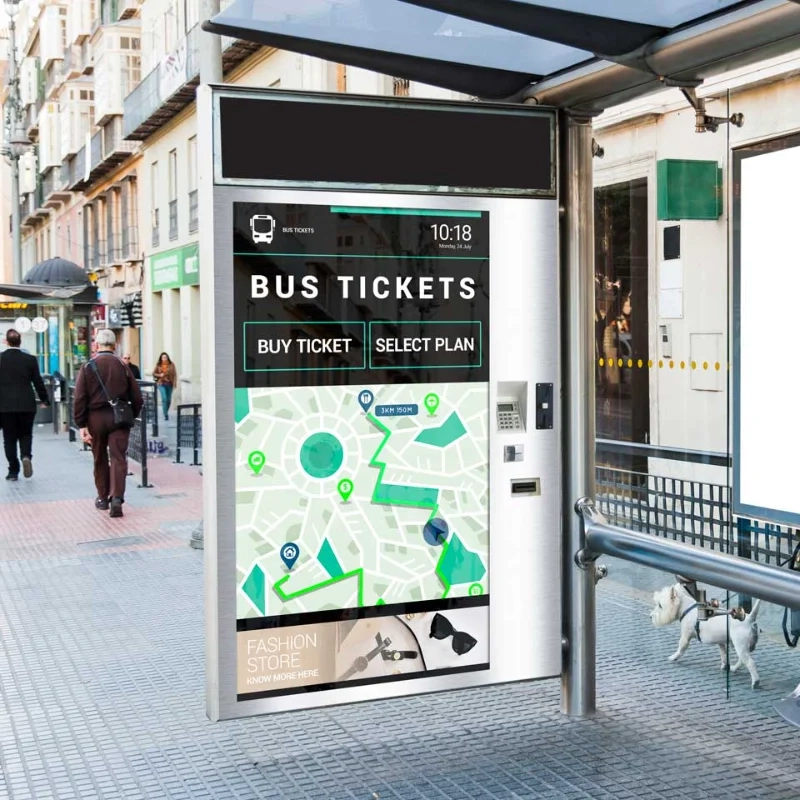
Durability is another crucial factor. Unlike consumer electronics, outdoor displays must operate reliably across a wide temperature range—from sub-zero conditions (-40°C) to scorching heat (+70°C). Specialized LCDs incorporate ruggedized packaging, such as sealed enclosures with IP65 or higher ingress protection ratings, to prevent dust, moisture, and mechanical damage. Some models also use tempered glass with scratch-resistant coatings, making them suitable for high-traffic environments like bus stops, construction sites, or military command centers.
Case studies illustrate the real-world impact of high-brightness sunlight-readable LCDs. In 2021, the city of Phoenix, Arizona deployed digital signage using 5,000 cd/m² sunlight-readable displays at major intersections and transit hubs. Before implementation, traditional LCDs were frequently unreadable during peak sun hours, leading to passenger confusion and delays. Post-deployment evaluations showed a 98% improvement in message comprehension, reducing miscommunication incidents by over 70%. Similarly, in the defense sector, the U.S. Army’s Enhanced Night Vision Goggles (ENVG) program adopted high-brightness LCDs for helmet-mounted displays, enabling soldiers to navigate complex terrains in both daylight and low-light conditions seamlessly.
Manufacturers like Sharp, Samsung Display, and AU Optronics have invested heavily in R&D to push the boundaries of what is possible in outdoor display technology. Recent innovations include micro-LED backlight arrays for ultra-high brightness, flexible OLED variants for curved installations, and AI-driven content optimization that adjusts display parameters based on time of day, weather, and viewer location. For example, a 2023 prototype developed by Sharp uses machine learning to predict optimal brightness settings for specific locations, thereby extending battery life and enhancing user experience.
From an industry standards perspective, organizations such as the International Electrotechnical Commission (IEC) and the American National Standards Institute (ANSI) provide guidelines for brightness, contrast, and environmental resilience testing. Compliance with IEC 60068-2-1 (cold test), IEC 60068-2-30 (humidity test), and ANSI/ISA-91.001-2021 (industrial control system display standards) ensures that these displays meet rigorous global benchmarks. Additionally, the MIL-STD-810G military specification is often referenced for durability testing under vibration, shock, and thermal cycling conditions—particularly important for defense and aerospace applications.
For businesses looking to adopt high-brightness sunlight-readable LCDs, it's essential to consider not just the technical specifications but also total cost of ownership (TCO). While these displays come at a premium compared to standard ones, their long-term benefits—reduced maintenance, extended lifespan, fewer replacements, and improved operational efficiency—often justify the investment. A 2022 report by MarketsandMarkets estimated the global high-brightness display market at $8.2 billion in 2023, with a projected CAGR of 7.4% through 2028, driven largely by increasing adoption in smart cities, electric vehicles, and autonomous systems.
Looking ahead, future trends point toward hybrid solutions combining LCD with emerging technologies like transparent OLEDs, laser projection, and augmented reality (AR) overlays. Researchers at MIT Media Lab are experimenting with transparent displays embedded in windshields for automotive applications, where high brightness and sunlight readability are non-negotiable. As edge computing and IoT integration become more prevalent, these displays will evolve into intelligent nodes within larger ecosystems—capable of receiving updates, adapting to environmental cues, and interacting with users through touchless interfaces.
In conclusion, high-brightness sunlight-readable LCD displays represent a convergence of cutting-edge materials science, optical engineering, and smart software design. They are no longer niche products reserved for specialized applications—they are becoming foundational infrastructure for modern outdoor digital experiences. Whether deployed in public spaces, industrial facilities, or military operations, these displays ensure that information remains clear, accessible, and actionable regardless of the environment. As global demand for robust, visible, and sustainable outdoor display solutions continues to rise, investing in this technology is not merely an option—it is a necessity for forward-thinking organizations across sectors.