 RisingStar
- Home
- About Us
- Products
- News
- Video
- Contact
- Send Inquiry
Search
- Home
- About Us
- Products
- News
- Video
- Contact
- Send Inquiry
RisingStar
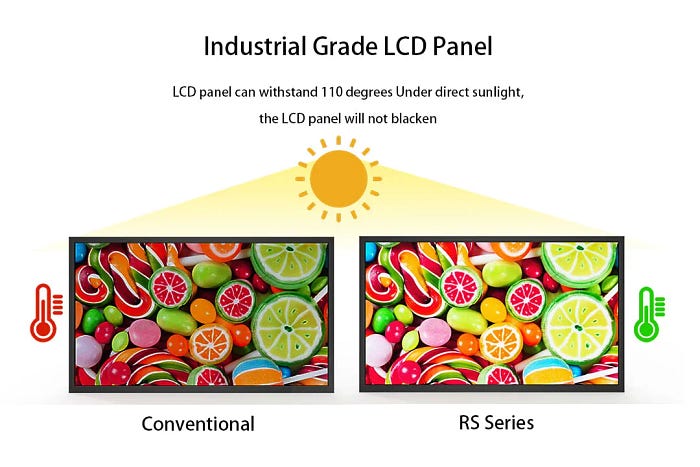
In today’s increasingly connected world, high-brightness sunlight-readable LCD screens have become indispensable in outdoor and industrial applications—from military field equipment and construction machinery to public transportation displays and solar energy monitoring systems. These screens are engineered to maintain visibility under extreme lighting conditions, including direct sunlight (up to 10,000 lux or more), glare, and varying ambient temperatures. The core challenge lies not just in achieving high luminance but also in maintaining contrast, color accuracy, and response time—without compromising power efficiency or durability.
Manufacturers like Sharp, LG Display, and AU Optronics lead the market by integrating advanced technologies such as transflective liquid crystal layers, high-efficiency LED backlighting, and proprietary optical films. Transflective technology combines reflective and transmissive modes: in bright sunlight, it uses ambient light like a mirror (reflective mode), reducing power consumption; indoors, it switches to full backlight illumination (transmissive mode). This dual-mode approach is essential for battery-powered devices in remote areas.
A key metric for evaluating sunlight-readability is peak brightness, typically measured in nits. While consumer-grade LCDs max out at 300–500 nits, industrial-grade panels must exceed 3,000 nits, with some models reaching 5,000–7,000 nits—enough to be visible even under direct midday sun. For example, the 7-inch VESA-compatible display used in tactical drones by Elbit Systems operates at 6,000 nits and meets MIL-STD-810G shock and vibration standards.
Contrast ratio is equally critical. High-brightness LCDs often use anti-glare coatings, polarization filters, and micro-lens arrays to reduce specular reflection while enhancing image clarity. A study published in the IEEE Transactions on Consumer Electronics (2022) demonstrated that displays with optimized anti-reflection (AR) coatings can improve readability by up to 40% in outdoor settings compared to uncoated panels.
Power management remains a persistent design constraint. To address this, manufacturers implement dynamic backlight dimming algorithms that adjust brightness based on ambient light sensors—a feature known as automatic brightness control (ABC). When integrated with adaptive refresh rate technology, these systems can reduce power consumption by 30–50% without sacrificing usability.
Moreover, environmental resilience matters. Industrial-grade LCDs must comply with IP65/IP67 ratings for dust and water resistance and operate reliably across a wide temperature range (-30°C to +70°C). For instance, the 10.4-inch ruggedized LCD from CUI Devices withstands -40°C to +85°C operation and includes an integrated touch panel resistant to glove use—a necessity for workers in cold climates.
Case studies validate real-world performance. In a deployment by Siemens for wind turbine monitoring systems, high-brightness sunlight-readable displays improved maintenance efficiency by 25%, as technicians could read sensor data accurately even during peak sunlight hours. Similarly, the U.S. Army’s AN/PRC-152 handheld radio integrates a 4.3-inch 5,000-nit display, enabling mission-critical operations in desert environments where standard screens would fail.
Ultimately, the evolution of high-brightness sunlight-readable LCDs reflects broader trends in human-machine interface (HMI) design: pushing the limits of visibility, durability, and energy efficiency. As industries move toward autonomous vehicles, smart infrastructure, and green energy systems, the demand for robust outdoor displays will only grow—making this segment one of the most vital innovations in modern display engineering.