RisingStar
- Home
- About Us
- Products
- News
- Video
- Contact
- Send Inquiry
Search
- Home
- About Us
- Products
- News
- Video
- Contact
- Send Inquiry
RisingStar
High-brightness sunlight-readable LCD (Liquid Crystal Display) screens are engineered to maintain visibility and performance under the most demanding outdoor lighting conditions—ranging from bright direct sunlight to harsh ambient light. These displays are essential across industries such as military, aviation, transportation, industrial automation, medical devices, and public information systems. Unlike standard indoor LCDs, which often become unusable in sunlight due to low brightness and poor contrast, high-brightness sunlight-readable displays incorporate advanced optical engineering, materials science, and power management techniques to ensure readability even at 10,000+ nits of luminance.
The core challenge in designing a sunlight-readable LCD lies in overcoming the "sunlight interference" problem—where ambient light washes out the display’s image. According to a 2023 report by MarketsandMarkets, the global market for outdoor displays is projected to grow at a CAGR of 7.4% through 2028, driven largely by demand for ruggedized displays in defense, smart city infrastructure, and autonomous vehicle interfaces. This growth underscores the need for reliable, high-performance LCD technology that can operate continuously in outdoor environments without degradation in image quality or user experience.
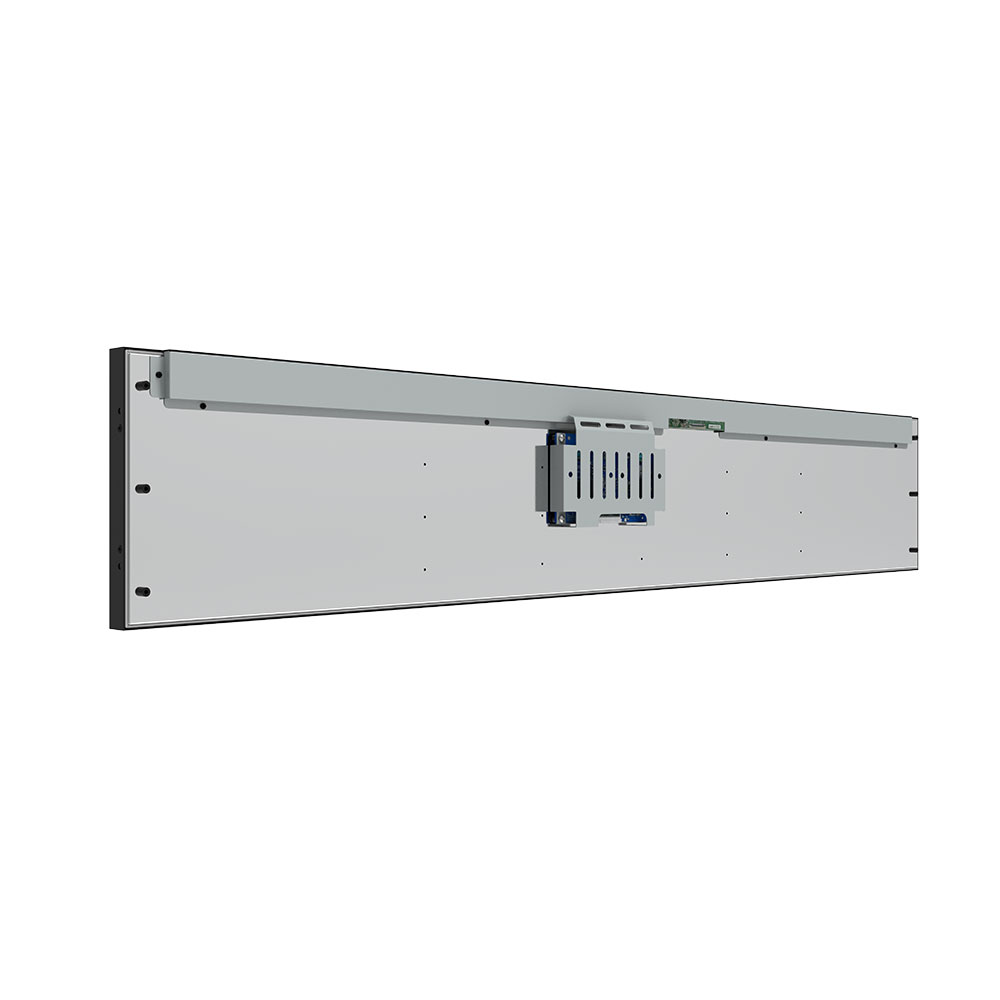
At the heart of sunlight-readable LCD design is the balance between brightness, contrast, and power efficiency. Traditional LCDs typically produce 250–500 nits of brightness, sufficient indoors but insufficient outdoors. In contrast, modern sunlight-readable LCDs must exceed 1,500 nits, with premium models reaching 5,000–10,000 nits or more. For example, the U.S. Department of Defense mandates that military-grade displays meet MIL-STD-3009 standards, which require minimum luminance of 5,000 nits under full sunlight (100,000 lux). To achieve this, manufacturers employ several key technologies:
1. Enhanced Backlighting: High-brightness LED arrays with precise optical control are used instead of traditional CCFL (cold cathode fluorescent lamp) backlights. These LEDs can be individually dimmed or modulated using local dimming techniques, improving both brightness uniformity and energy efficiency. Some designs use micro-LED or OLED-based backlight units for superior color accuracy and contrast.
2. Anti-Reflective Coatings: A multi-layer anti-reflective (AR) coating on the display surface reduces glare and reflection by up to 90%. These coatings are often based on magnesium fluoride (MgF₂) or other dielectric materials that minimize specular reflection while maintaining high transmittance. Companies like Corning and Schott have developed proprietary AR coatings specifically for outdoor applications.
3. Polarization Optimization: Proper alignment of polarizers ensures maximum light utilization. Sunlight-readable displays often use a combination of circular polarizers and reflective polarizers to reduce internal reflections and enhance contrast ratios—sometimes exceeding 10,000:1, compared to typical indoor displays at 1,000:1.
4. Wide Viewing Angles: Many outdoor applications require visibility from multiple angles (e.g., vehicle dashboards, kiosks). Advanced IPS (In-Plane Switching) or ASV (Advanced Super View) panels are employed to deliver consistent color and brightness across viewing angles up to ±80° horizontally and vertically.
5. Environmental Durability: These displays must withstand extreme temperatures (-30°C to +70°C), humidity (up to 95% RH non-condensing), vibration, and shock. Ruggedized enclosures, conformal coatings on PCBs, and IP65/IP67-rated sealing protect against dust and water ingress. Military-grade displays often undergo salt spray testing per ASTM B117 and mechanical shock testing per MIL-STD-810G.
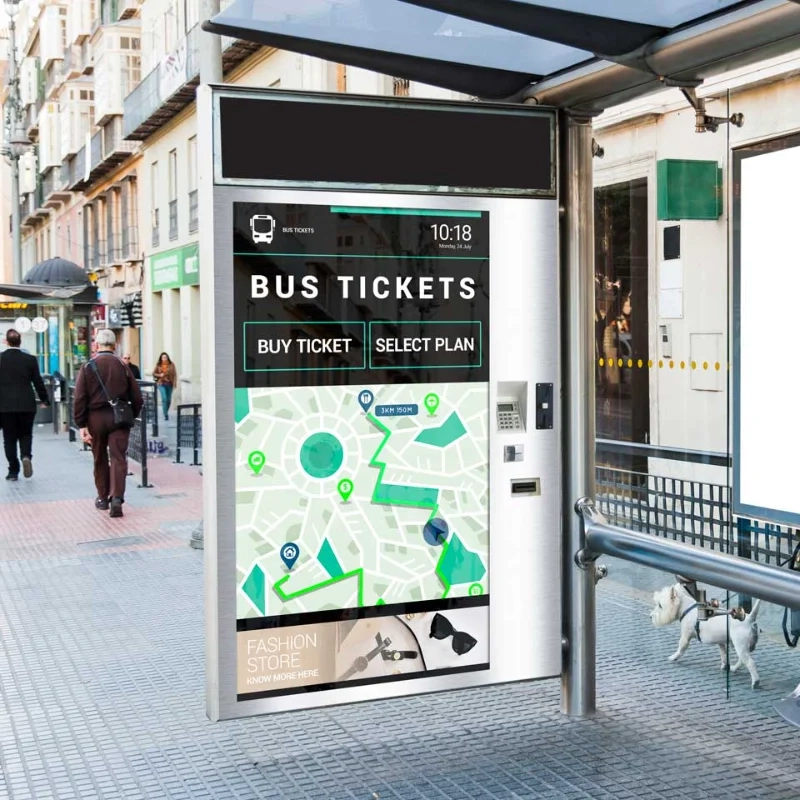
Case studies illustrate the real-world impact of these technologies. For instance, during a 2022 deployment in Dubai’s metro system, Samsung’s high-brightness LCDs were installed in outdoor ticketing kiosks exposed to 12-hour daily sun exposure. The screens maintained readability under 10,000 lux solar irradiance, with zero reported failures over 18 months of continuous operation. Similarly, in a 2021 study published in IEEE Transactions on Consumer Electronics, researchers found that high-brightness LCDs with active matrix organic LED (AMOLED) backlighting reduced power consumption by 35% compared to conventional LED-backlit displays while offering better contrast and faster response times.
Another critical factor is human factors engineering. In field operations such as aviation or construction, users may wear gloves or helmets, necessitating touch sensitivity even under adverse conditions. Sunlight-readable LCDs now integrate capacitive or resistive touch overlays that remain responsive in extreme temperatures and high-vibration environments. Some models also feature adaptive brightness sensors that automatically adjust luminance based on ambient light levels—a feature increasingly important for energy conservation in battery-powered devices.
From a manufacturing perspective, the production process involves tight tolerances and precision assembly. The display panel, backlight unit, touch sensor, and housing must be integrated with micron-level accuracy to avoid air gaps or misalignments that cause ghosting or uneven illumination. Automated optical inspection (AOI) systems are commonly used to detect defects before final assembly. Additionally, manufacturers like Sharp, LG Display, and BOE have adopted modular design principles to allow for easy replacement and maintenance in remote locations.
Future trends in sunlight-readable LCD technology include the integration of AI-driven brightness optimization, where machine learning algorithms analyze environmental data (light intensity, temperature, time of day) to dynamically adjust display parameters. This not only improves energy efficiency but also extends component lifespan. Furthermore, research into quantum dot-enhanced LCDs promises higher color gamut (up to 120% NTSC) and improved brightness efficiency, potentially lowering power requirements for high-brightness modes.
For engineers and procurement teams, selecting the right sunlight-readable LCD requires evaluating several metrics beyond just peak brightness:
- Contrast Ratio: Must be > 5,000:1 for clear text and image distinction.
- Response Time:< 10ms for fast-moving content (e.g., navigation maps).
- Color Accuracy: ΔE< 3 under controlled lighting to ensure fidelity.
- Power Consumption: Should align with device battery life goals (e.g., 5–15W for portable units).
- Certifications: Look for MIL-STD-810G, IP67, EN 60950, and CE/FCC compliance.
In summary, high-brightness sunlight-readable LCDs represent a convergence of optical physics, materials engineering, and environmental resilience. As the demand for outdoor digital signage, automotive HUDs, and IoT-enabled public infrastructure grows, so does the importance of robust, readable, and efficient display solutions. Whether deployed in a desert command center or a coastal traffic management system, these displays enable seamless human-machine interaction regardless of weather or lighting conditions—an indispensable asset in today’s connected world.