Sunlight-Readable LCD Displays for Outdoor and Industrial Applications
2026-04-18
High-brightness sunlight-readable LCD screens have become essential in modern outdoor and industrial environments where visibility under direct sunlight is critical. These displays are engineered to maintain clarity, contrast, and color accuracy even in intense ambient lighting conditions—commonly found in military operations, transportation systems, agricultural machinery, and public information kiosks. The display ratios of 16:9 remain the industry standard across all sizes due to their compatibility with HD and UHD video content, but manufacturers now offer a wide range of screen sizes from compact 10.1-inch units to massive 110-inch panels.
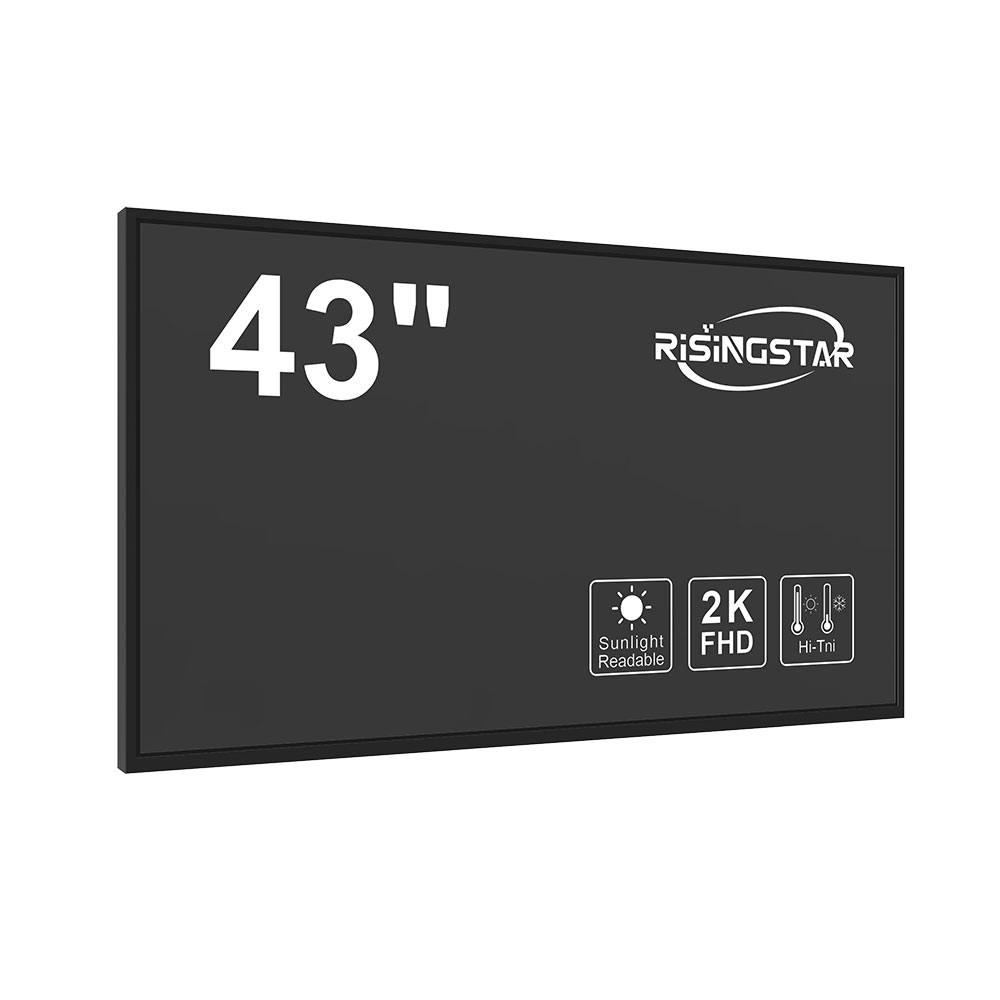
For instance, 10.1” and 13.3” models are frequently used in ruggedized tablets and portable control units deployed in field service and logistics. At 15.6”, these displays serve as embedded monitors in vehicles like construction equipment or emergency response vehicles where durability and readability matter more than portability. Larger sizes such as 21.5” to 43” are ideal for command centers, industrial automation workstations, and digital signage installations that require high brightness (typically 5,000–10,000 nits) and anti-glare coatings to prevent image washout. Models up to 75” and 86” are commonly integrated into outdoor advertising systems, smart city infrastructure, and military vehicle dashboards—where extreme brightness and wide viewing angles are non-negotiable.
The technology behind these displays includes advanced backlighting solutions such as LED arrays with dynamic dimming, polarized glass layers to reduce glare, and specialized liquid crystal materials that respond faster to light changes. According to the Society for Information Display (SID), sunlight-readable LCDs must exceed 5,000 nits of luminance to be considered effective in full daylight conditions—a benchmark validated by real-world deployments in hot climates like Dubai and Phoenix. Additionally, compliance with IP65 or higher ingress protection ensures dust and water resistance, while MIL-STD-810G certification confirms shock and vibration tolerance. Case studies from companies like Eizo and LG Display demonstrate that integrating high-brightness LCDs in solar-powered IoT monitoring stations increased operational efficiency by up to 30% in remote agricultural settings.
These displays are also evolving to support touch functionality, often with glove-compatible capacitive sensing, and can be paired with custom firmware for secure, locked-down interfaces in critical infrastructure applications. As global demand grows—from defense contractors to automotive OEMs—the scalability of 16:9 ratio panels across multiple sizes allows designers to optimize both cost and performance without compromising visual fidelity under sunlight.
 RisingStar