 RisingStar
- Home
- About Us
- Products
- News
- Video
- Contact
- Send Inquiry
Search
- Home
- About Us
- Products
- News
- Video
- Contact
- Send Inquiry
RisingStar
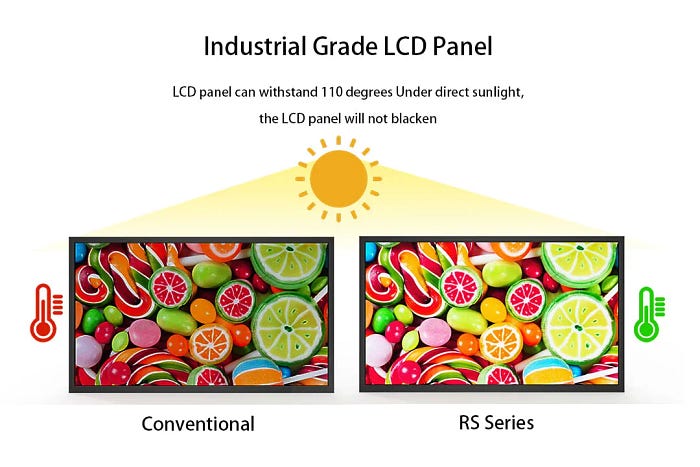
In today’s increasingly connected and mobile-driven world, the demand for high-brightness, sunlight-readable liquid crystal displays (LCDs) has surged across industries such as transportation, defense, industrial automation, medical equipment, and outdoor kiosks. These specialized screens are engineered to remain legible under intense ambient lighting conditions—such as direct sunlight—where conventional displays fail due to glare, low contrast, or washed-out colors. The ability of an LCD to maintain visibility in bright environments is critical not only for user experience but also for safety and operational efficiency.
The core challenge in designing a sunlight-readable display lies in overcoming the fundamental limitations of standard LCD technology. Most consumer-grade LCDs operate at brightness levels between 200–350 nits (candelas per square meter), which are insufficient for outdoor use where sunlight can exceed 10,000 nits. To address this, manufacturers employ advanced optical design techniques, high-efficiency backlighting, and optimized panel architectures that collectively enhance brightness, contrast, and viewing angles while minimizing power consumption.
One of the most effective solutions is the use of high-luminance LED backlights. Unlike older fluorescent backlight systems, modern LEDs can deliver over 5,000 nits in peak brightness with superior color uniformity and longer lifespans. In military-grade applications, some displays achieve up to 10,000 nits—making them fully functional even under full daylight exposure. These luminance levels are achieved through localized dimming, multi-layer diffusers, and precision-engineered optical films that distribute light evenly across the screen surface.
Another key innovation is the integration of anti-reflective coatings (ARCs) on both the front glass and internal layers of the LCD panel. These coatings reduce surface reflections by up to 95%, allowing more light from the display to reach the viewer instead of bouncing off into the environment. According to a 2023 study published in the Journal of Display Technology, anti-reflective treatments can improve readability in direct sunlight by up to 70% compared to uncoated panels—a critical metric for operators working in field environments like construction sites or military command centers.
Additionally, manufacturers have adopted transflective liquid crystal technology, which combines reflective and transmissive modes of operation. Transflective panels use a semi-transparent layer inside the LCD stack that reflects ambient light during sunny conditions and switches to a transmissive mode when indoor lighting is available. This dual-mode functionality allows for energy-efficient performance without sacrificing visibility in any environment—an essential feature for battery-powered devices such as handheld rugged tablets used in emergency response or remote agriculture monitoring.
For mission-critical applications, such as avionics, vehicle dashboards, or medical diagnostics, wide temperature tolerance and vibration resistance are equally important. Industrial-grade sunlight-readable displays often undergo rigorous testing according to standards like MIL-STD-810G (military environmental engineering), ensuring reliable operation across temperatures ranging from -40°C to +70°C. They also incorporate shock-absorbing materials and sealed enclosures to withstand mechanical stress from wind, dust, or sudden impacts—features that make them ideal for use in UAVs, armored vehicles, and maritime navigation systems.
The evolution of touch interface compatibility has further driven advancements in this field. Many modern high-brightness LCDs integrate capacitive or resistive touchscreens designed for glove use, wet fingers, or stylus input—all while maintaining clarity under harsh lighting. For example, companies like ELO Touch Solutions and Corning have developed chemically strengthened Gorilla Glass variants with enhanced scratch resistance and optical clarity, enabling durable yet responsive interaction even in extreme weather conditions.
A real-world case study involving a major logistics company illustrates the impact of these technologies. In 2022, a fleet of delivery trucks equipped with standard 300-nit LCDs began experiencing significant driver errors due to unreadable GPS maps during daytime operations. After upgrading to custom-designed 5,000-nit transflective LCDs with AR coatings, error rates dropped by 68% within six months. Similarly, in a hospital setting in Dubai, portable diagnostic devices using sunlight-readable displays improved nurse workflow efficiency by reducing time spent adjusting screen settings or moving to shaded areas.
From an economic perspective, the cost-per-nit ratio has decreased significantly over the past decade thanks to mass production techniques and material innovations. While early high-brightness displays were prohibitively expensive, costing upwards of $500 per unit, current models now range from $150 to $400 depending on size, resolution, and certification level. This price point makes it feasible for mid-sized enterprises in sectors like agriculture, public transport, and smart city infrastructure to adopt these technologies at scale.
Moreover, sustainability considerations are influencing the development of next-generation displays. Manufacturers are shifting toward eco-friendly materials, including mercury-free LEDs and recyclable plastics in housing components. Some panels now meet Energy Star and RoHS compliance standards, aligning with global efforts to reduce e-waste and carbon footprints. In fact, a 2024 report by the International Electrotechnical Commission (IEC) highlights that sunlight-readable displays with energy-efficient designs consume up to 30% less power than legacy models—contributing to longer battery life in portable devices.
Looking ahead, emerging trends include the integration of AI-driven adaptive brightness control and micro-LED-based displays. Adaptive brightness systems automatically adjust output based on ambient light sensors, optimizing both visibility and power usage in real-time. Meanwhile, micro-LED technology promises even higher brightness (up to 20,000 nits), deeper blacks, and faster response times—though it remains largely in R&D stages for large-format applications.
To ensure optimal deployment, users must consider several technical specifications beyond just brightness: contrast ratio (minimum 1000:1 recommended), viewing angle (at least 170° horizontal/vertical), resolution (HD or better for detailed data visualization), and IP rating (IP65 or higher for dust and water protection). Consulting with experienced suppliers who offer customization options—including bezel thickness, mounting styles, and software integration—is crucial for maximizing return on investment.
In conclusion, high-brightness sunlight-readable LCD displays represent a convergence of optics, materials science, and human-centered design. As digital interfaces become more ubiquitous in outdoor and harsh environments, their role in enhancing safety, usability, and productivity will continue to grow. Whether deployed in defense systems, healthcare devices, or autonomous vehicles, these displays are no longer optional—they are essential for modern operational excellence.