RisingStar
- Home
- About Us
- Products
- News
- Video
- Contact
- Send Inquiry
Search
- Home
- About Us
- Products
- News
- Video
- Contact
- Send Inquiry
RisingStar
In outdoor environments, display readability under direct sunlight is a critical design challenge. High-brightness sunlight-readable LCD screens have become essential in industries such as transportation, military, industrial automation, and consumer electronics. These displays are engineered to maintain visibility even in extreme lighting conditions—up to 10,000 lux or more—where conventional LCDs fail due to glare, contrast loss, and poor visibility.
The core innovation behind high-brightness sunlight-readable LCDs lies in their ability to increase luminance while optimizing contrast through specialized backlighting, anti-glare coatings, and advanced liquid crystal technologies. For example, many modern models utilize LED backlights with brightness levels exceeding 5,000 nits (cd/m²), far surpassing standard indoor displays that typically operate at 300–500 nits. This ensures the screen remains legible under full sun exposure without increasing power consumption disproportionately.
One of the most effective strategies for enhancing sunlight readability is the use of transflective LCD technology. Unlike traditional transmissive LCDs that rely solely on a backlight, transflective panels combine reflective and transmissive layers. During daylight, ambient light is reflected off the internal mirror layer, reducing dependency on the backlight. At night or in low-light conditions, the backlight activates seamlessly. This dual-mode operation significantly improves energy efficiency and extends battery life in portable devices—a key advantage for field-deployed equipment like handheld scanners or ruggedized tablets.
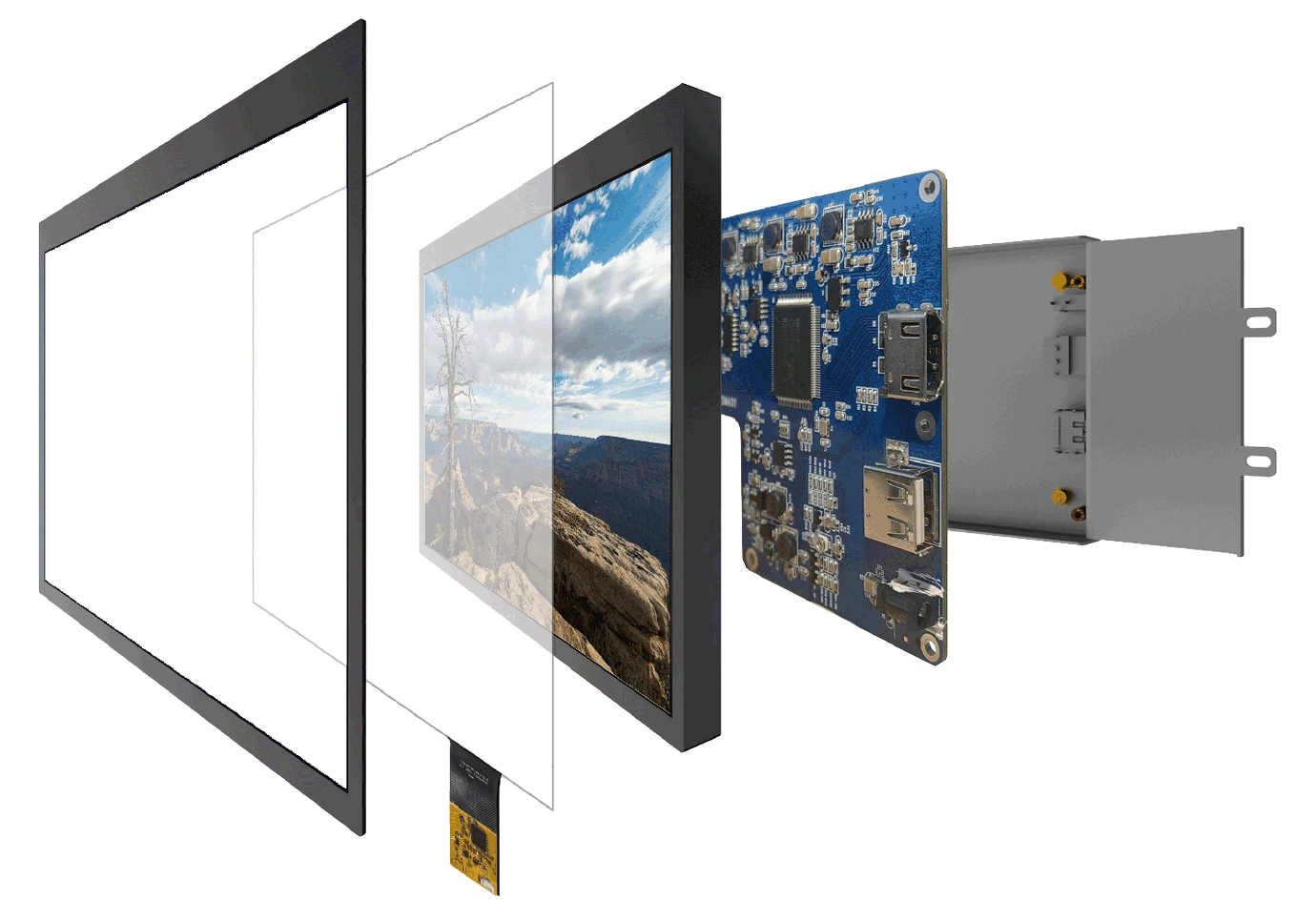
Another crucial component is the application of anti-reflective (AR) coatings on the display surface. These nanostructured coatings reduce specular reflection by up to 90%, preventing glare from interfering with image clarity. Some manufacturers also integrate polarizing filters and diffusers to further enhance contrast ratios—often reaching 1000:1 or higher—even under bright sunlight. Additionally, optical bonding techniques, where the cover glass is bonded directly to the LCD panel using transparent adhesive, eliminate air gaps that cause internal reflections, improving both durability and visual performance.
Case studies from real-world deployments reinforce these technical advantages. For instance, a 2022 study published in the Journal of Display Technology highlighted how a military-grade sunlight-readable LCD used in UAV ground control stations maintained 98% readability at 8,000 lux, compared to only 45% for a standard indoor display. Similarly, companies like Bixolon and C&K Electronics have successfully implemented high-brightness solutions in vending machines, kiosks, and public transit information systems, reporting improved user engagement and reduced maintenance costs due to better long-term reliability.
Compliance with international standards such as MIL-STD-810G (for environmental durability), ISO 16750 (for automotive electronics), and EN 60950 (for safety) ensures that these displays meet rigorous operational requirements across diverse climates—from arid deserts to humid tropical zones. Many manufacturers now offer customizable options including wide temperature ranges (-30°C to +70°C), IP65/IP67 dust and water resistance, and touch interfaces compatible with gloves or styluses.
From an engineering perspective, the future of sunlight-readable LCDs includes advancements in micro-LED backlighting, quantum dot enhancements, and AI-driven dynamic brightness adjustment algorithms that optimize both energy use and visual quality in real time. As outdoor digital signage, smart city infrastructure, and autonomous vehicle dashboards continue to expand globally, the demand for robust, readable displays will only grow.
These innovations are not just about brighter screens—they represent a convergence of optics, materials science, human factors, and system-level integration. Whether for mission-critical operations or everyday consumer use, high-brightness sunlight-readable LCDs are transforming how humans interact with digital information in open-air environments.