RisingStar
- Home
- About Us
- Products
- News
- Video
- Contact
- Send Inquiry
Search
- Home
- About Us
- Products
- News
- Video
- Contact
- Send Inquiry
RisingStar
In today’s increasingly digital world, high-brightness sunlight-readable LCD screens have become essential components in a wide range of outdoor applications—from military and industrial equipment to transportation systems and public information displays. These specialized displays are engineered to remain fully visible under intense solar radiation, where conventional LCDs fail due to low contrast, washed-out colors, or complete invisibility. As global demand rises for robust, reliable, and energy-efficient display solutions in harsh environments, manufacturers must adhere to stringent standards such as MIL-STD-810 (military durability), ISO 16750 (automotive environmental testing), and IEC 60068 (general environmental testing). This article delves into the technological foundations, design principles, material innovations, real-world applications, and future trends shaping high-brightness sunlight-readable LCD technology—providing a comprehensive technical overview for engineers, procurement managers, and system integrators.
At the heart of a sunlight-readable LCD is its ability to achieve brightness levels between 3,000 and 10,000 nits—a dramatic increase over standard indoor LCDs that typically max out at 500–1,000 nits. This extreme luminance is achieved through several key mechanisms. First, advanced LED backlighting using high-efficiency, high-luminance LEDs ensures sufficient light output even under direct sunlight. For instance, modern full-array local dimming (FALD) systems dynamically adjust brightness zones across the screen to optimize both visibility and power efficiency. Second, anti-glare coatings and polarized filters reduce surface reflections by up to 90%, minimizing the "mirror effect" common on glossy panels exposed to sunlight. Third, enhanced contrast ratios—often exceeding 10,000:1—are achieved via superior panel technologies like IPS (In-Plane Switching) or VA (Vertical Alignment) with optimized black matrix designs and narrow viewing angles to minimize ambient light interference.
The materials used in constructing these screens are equally critical. Manufacturers now employ ultra-thin glass substrates treated with hydrophobic and oleophobic layers to resist water, oil, and dust accumulation—a necessity in field deployments. Additionally, the use of reinforced polymer films instead of traditional glass in some ruggedized models improves impact resistance while maintaining optical clarity. Case studies from defense contractors like Raytheon and automotive suppliers such as Bosch demonstrate that integrating sealed, IP67-rated enclosures with active cooling fans significantly extends operational life in extreme temperatures ranging from -40°C to +70°C.
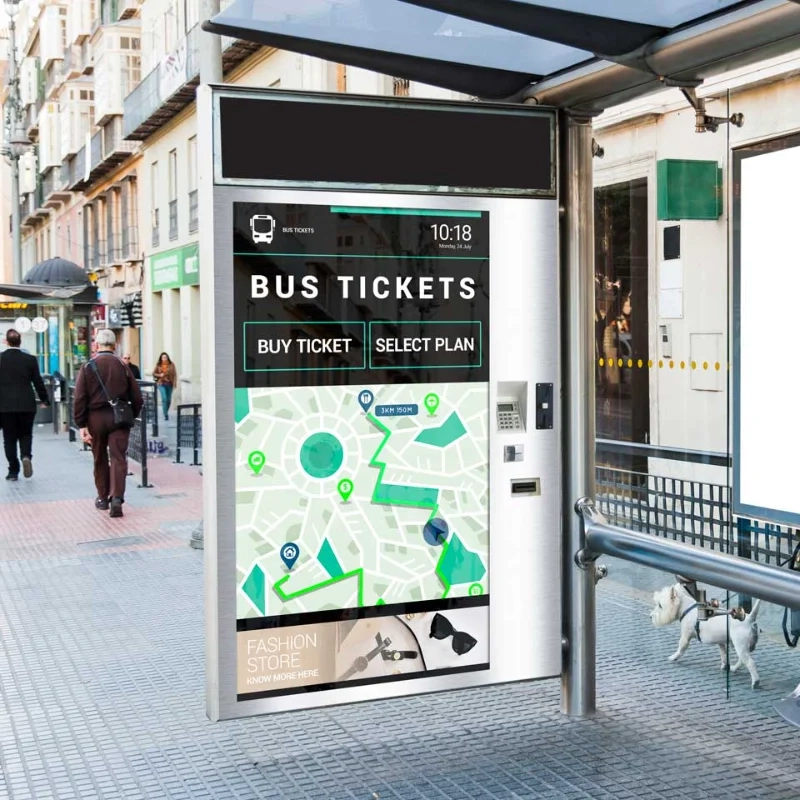
Real-world applications further validate the importance of this technology. In the transportation sector, cities like Singapore and Tokyo have adopted high-brightness LCDs in their transit kiosks and digital signage, enabling clear navigation during midday sun. Similarly, construction sites utilize portable control units equipped with 5,000-nit displays for crane operations, ensuring operator safety in bright conditions. Military applications include battlefield command centers and UAV ground stations, where readability under full sunlight can mean the difference between mission success and failure. According to a 2023 report by MarketsandMarkets, the global market for sunlight-readable displays was valued at $1.2 billion in 2022 and is projected to reach $2.5 billion by 2028, driven primarily by growth in defense, automotive, and smart infrastructure sectors.
From an engineering standpoint, thermal management remains one of the biggest challenges. High-brightness backlights generate significant heat, which can degrade liquid crystal performance and shorten component lifespan. To address this, manufacturers implement intelligent thermal regulation systems, including heat pipes, vapor chambers, and closed-loop airflow designs. Some models integrate sensors that automatically reduce brightness when ambient light decreases, thereby balancing performance and longevity—an approach supported by the IEEE Transactions on Components, Packaging and Manufacturing Technology (2021). Furthermore, advancements in OLED-based sunlight-readable displays offer promise for even higher contrast and faster response times, though cost and durability still pose barriers to widespread adoption.
Looking ahead, the integration of AI-driven adaptive brightness algorithms and edge computing capabilities will define the next generation of these screens. Imagine a display that not only adjusts based on ambient light but also learns user behavior patterns—for example, increasing brightness during peak usage hours or dimming during periods of low activity to conserve battery. Such features are already being piloted in mobile command vehicles by Northrop Grumman and Samsung SDS. Moreover, emerging standards like EN 60950-1 (safety requirements for IT equipment) and UL 1950 are pushing manufacturers toward safer, more sustainable practices in production and end-of-life disposal.
Ultimately, high-brightness sunlight-readable LCD screens represent a convergence of optics, materials science, thermal engineering, and software intelligence. They are no longer niche products but mainstream necessities in industries where visibility equals safety, accuracy, and productivity. As climate change intensifies solar exposure in many regions—and as global urbanization drives demand for resilient public tech infrastructure—the evolution of these displays will continue to be a pivotal enabler of smarter, safer, and more connected environments.