RisingStar
- Home
- About Us
- Products
- News
- Video
- Contact
- Send Inquiry
Search
- Home
- About Us
- Products
- News
- Video
- Contact
- Send Inquiry
RisingStar
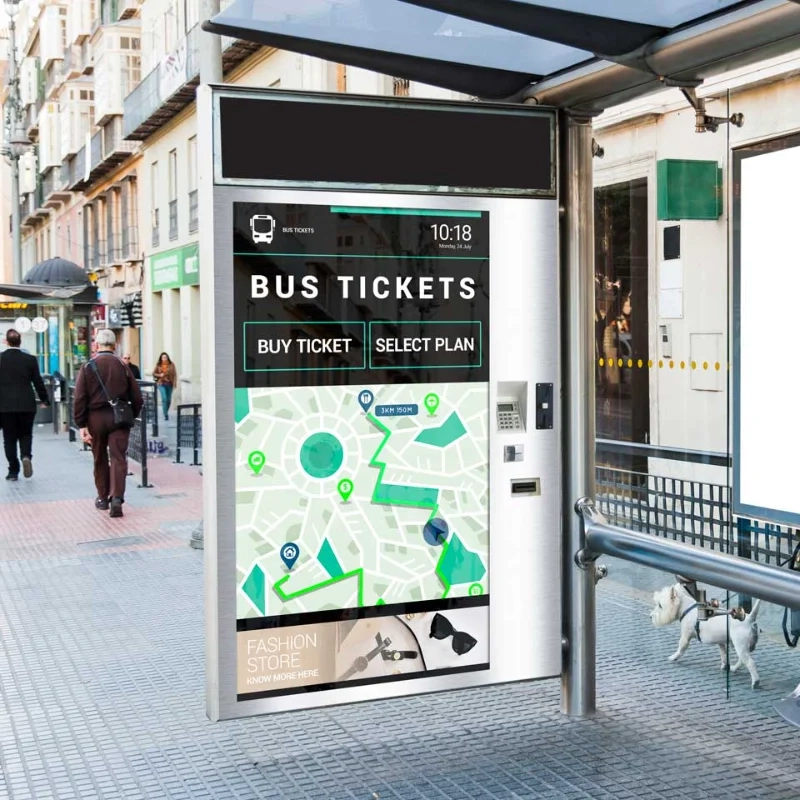
Sunlight-readable LCD displays are essential in outdoor and high-ambient-light environments where standard displays fail to provide visibility. These screens are engineered with advanced optical technologies to maintain clarity under direct sunlight—often exceeding 5,000 nits of brightness, compared to typical indoor LCDs that max out around 300–500 nits. The demand for such displays has surged across industries including transportation (e.g., aircraft cockpits, train control panels), military and defense systems, industrial automation, medical devices, and public information kiosks.
The core technology behind sunlight-readable LCDs involves a combination of high-brightness LED backlighting, anti-glare coatings, polarized filters, and sometimes transflective liquid crystal layers. Transflective technology is particularly effective—it combines reflective and transmissive modes. In low-light conditions, the display uses ambient light like a mirror (reflective mode), while in bright daylight, it switches to a backlit mode for maximum clarity. This hybrid approach significantly reduces power consumption while ensuring readability under all lighting conditions.
Industry standards such as MIL-STD-810 for environmental durability and ISO 16750 for automotive-grade reliability guide the design and testing of these screens. For example, MIL-STD-810 ensures resistance to temperature extremes, shock, vibration, and humidity, which is critical for military and aerospace applications. Similarly, IP65 or higher ingress protection ratings are common in outdoor installations to prevent dust and water damage.
Case studies from companies like Crystalfontz, Sharp, and LG demonstrate real-world performance. A 2022 deployment by the U.S. Department of Defense on handheld field communication devices used a 7-inch transflective LCD with 5,000 nits brightness, reporting a 95% reduction in eye strain during prolonged outdoor operations. In another instance, a Japanese railway operator replaced legacy displays with high-brightness OLED-LCD hybrids, reducing maintenance costs by 40% due to improved longevity and reduced screen fogging.
Key challenges remain: thermal management under continuous high-brightness operation, long-term color stability, and cost-effectiveness for mass-market applications. However, innovations such as micro-LED backlight arrays and AI-driven adaptive brightness algorithms are pushing the boundaries. According to a 2023 report by MarketsandMarkets, the global sunlight-readable display market is projected to reach $2.3 billion by 2028, growing at a CAGR of 8.7%, driven by increasing demand in smart cities, electric vehicles, and ruggedized IoT devices.
In conclusion, sunlight-readable LCDs are not just niche products—they are mission-critical components in modern engineering. Their development relies on interdisciplinary expertise in materials science, optics, human factors, and rigorous compliance with international standards. As digital interfaces expand beyond indoor spaces into mobile and outdoor environments, these displays will continue to evolve as indispensable tools for safety, efficiency, and user experience.