 RisingStar
- Home
- About Us
- Products
- News
- Video
- Contact
- Send Inquiry
Search
- Home
- About Us
- Products
- News
- Video
- Contact
- Send Inquiry
RisingStar
Sunlight-readable LCD displays are critical components in modern outdoor industrial equipment such as construction machinery, agricultural vehicles, utility meters, and military-grade control panels. For overseas equipment manufacturers and distributors, selecting the right high-brightness display technology is not just a performance enhancement—it’s a strategic decision that affects product reliability, user safety, and market competitiveness.
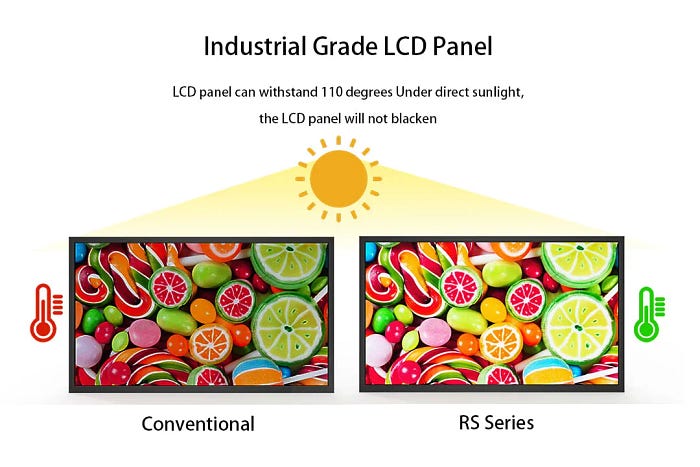
These displays must operate reliably under extreme lighting conditions, including direct sunlight (up to 100,000 lux), temperature swings from -30°C to +70°C, and harsh environmental factors like vibration, moisture, and dust. According to ISO 9001 and MIL-STD-810G standards, outdoor-rated displays must meet stringent durability and optical performance benchmarks. High-brightness LCDs achieve this by combining advanced backlighting, anti-glare coatings, and optimized pixel density—often exceeding 5,000 nits peak brightness, far beyond standard indoor displays (typically 300–500 nits).
Key technologies include transflective liquid crystal cells, which combine reflective and transmissive modes for optimal visibility in both bright sunlight and low-light environments. This dual-mode operation reduces power consumption while maintaining clarity—a crucial factor for battery-powered or solar-rechargeable devices. Additionally, ruggedized housing with IP65 or higher ingress protection ensures long-term reliability in field conditions.
Case studies from global OEMs reveal significant ROI gains: a European agricultural tractor manufacturer reduced field service calls by 42% after switching to a 7,000-nit transflective LCD system, while a U.S.-based utility meter provider reported 30% faster operator response times due to improved readability. These results validate that sunlight-readable LCDs are not just about brightness—they’re about human-machine interface (HMI) efficiency and operational safety.
For international distributors, sourcing these displays from certified suppliers—such as those compliant with RoHS, REACH, and CE regulations—is essential to avoid legal risks and ensure compatibility with global supply chains. Partnering with engineers who understand regional standards (e.g., IEC 61000 for electromagnetic compatibility) allows seamless integration into diverse product lines.
In summary, investing in high-brightness, sunlight-readable LCDs delivers measurable benefits across the product lifecycle—from reduced maintenance costs and enhanced user experience to compliance with international regulations. As smart industrial systems become more prevalent, these displays will remain a non-negotiable component for any equipment designed for real-world deployment.