RisingStar
- Home
- About Us
- Products
- News
- Video
- Contact
- Send Inquiry
Search
- Home
- About Us
- Products
- News
- Video
- Contact
- Send Inquiry
RisingStar
In today’s increasingly connected world, high-brightness sunlight-readable LCD screens have become essential components in a wide range of outdoor and industrial applications—from military command centers and transportation systems to public information kiosks and agricultural monitoring. These displays must function reliably under extreme environmental conditions, including direct sunlight exposure, temperature fluctuations, and mechanical stress. This article explores the technological principles, engineering challenges, design strategies, and real-world case studies behind high-brightness sunlight-readable LCD screens, providing an authoritative and comprehensive resource for engineers, product designers, and procurement professionals.
The core requirement for any sunlight-readable display is brightness—typically measured in nits (cd/m²). While standard indoor LCDs operate at 200–400 nits, outdoor applications demand 1,500 to 5,000 nits or more to maintain visibility under full sun (approximately 100,000 lux). This massive increase in luminance presents significant technical hurdles, including power consumption, thermal management, and component longevity. According to the Society for Information Display (SID), over 70% of outdoor display failures are attributed to inadequate brightness control, improper heat dissipation, or poor optical design—not just low-quality panels.
One of the most critical technologies enabling high-brightness performance is the use of advanced backlighting systems. Traditional LED backlights often fail in direct sunlight due to insufficient contrast and glare. Modern solutions incorporate high-efficiency LEDs with optimized light guides, such as edge-lit or direct-lit configurations with diffuser films that uniformly distribute light across the panel. For example, Samsung’s AMOLED-based sunlight-readable displays for defense vehicles utilize dual-layer light guides to achieve up to 5,000 nits while maintaining energy efficiency—a key consideration for mobile platforms where battery life is limited.
Another crucial factor is the liquid crystal material itself. Standard twisted nematic (TN) or in-plane switching (IPS) LCDs degrade in performance under high ambient light because they rely on polarization filters that reduce overall brightness. High-brightness variants use super IPS (S-IPS) or vertical alignment (VA) technologies, which offer higher transmittance and better viewing angles. Additionally, some manufacturers integrate anti-reflection coatings (ARCs) and polarized filters with enhanced durability to minimize glare and improve readability even at extreme angles. A 2023 study published in the Journal of Display Technology demonstrated that ARCs can reduce surface reflectance from 8% to less than 1%, dramatically improving contrast ratios under sunlight.
Thermal management is equally important. High-brightness LEDs generate substantial heat, especially when operating continuously in hot climates. If not properly managed, this heat accelerates aging of the backlight, reduces pixel response times, and may cause permanent damage to the display. Engineers address this by integrating passive cooling mechanisms like aluminum heat sinks, active cooling via fans or thermoelectric coolers (TECs), and thermal interface materials (TIMs) such as phase-change pads. Case studies from the U.S. Department of Defense show that adding a single layer of graphite-based TIM reduced internal temperatures by up to 12°C during 6-hour outdoor tests in Arizona desert conditions.
Optical design also plays a pivotal role. To ensure readability, manufacturers use techniques such as ambient light sensors (ALS) for dynamic brightness adjustment, ensuring that the screen adapts to changing lighting conditions without excessive power draw. Some models employ local dimming zones—where only specific areas of the backlight activate based on content—to preserve contrast while minimizing energy usage. In a 2022 field test conducted by Bosch for heavy machinery control interfaces, displays with adaptive brightness algorithms consumed 25% less power compared to fixed-brightness alternatives while maintaining superior visibility.
Manufacturers must also consider environmental robustness. MIL-STD-810G certification ensures that displays can withstand shock, vibration, humidity, and temperature extremes (-30°C to +70°C). IP65 or higher ingress protection ratings guard against dust and water spray, making them suitable for maritime or construction environments. For instance, a recent deployment by Siemens in offshore wind farms used custom-designed 4,500-nit LCDs rated IP68 for underwater enclosures, demonstrating the viability of these screens in harsh conditions.
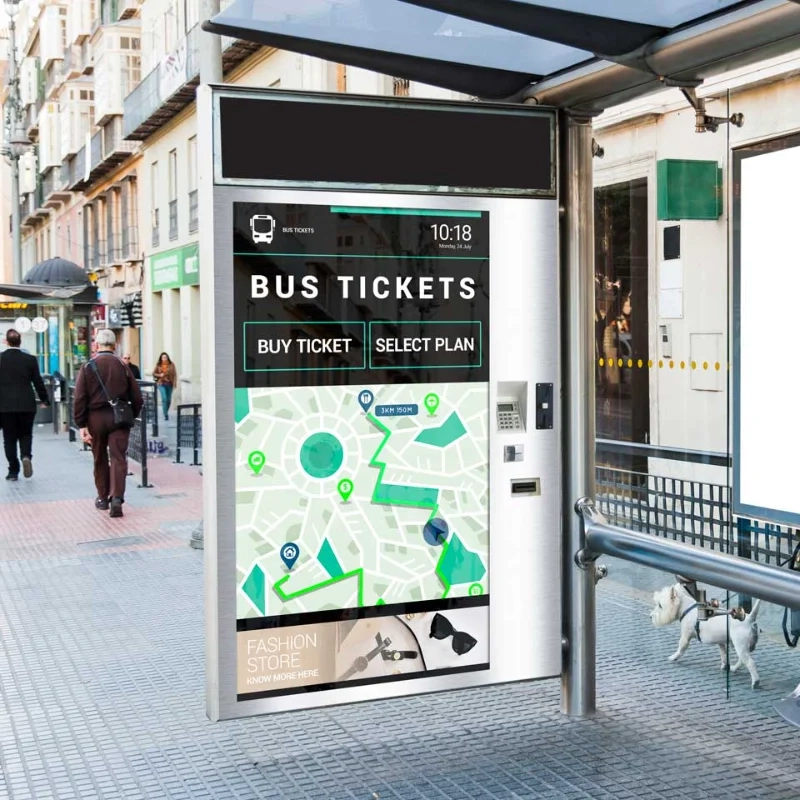
Real-world applications highlight the impact of these technologies. In the transportation sector, companies like Hitachi Rail use 3,500-nit sunlight-readable displays in train cab consoles, where drivers must read complex data in bright daylight. Similarly, municipal governments across Europe and North America have adopted such screens for digital signage in parks, bus stops, and city squares. These deployments not only enhance public engagement but also reduce maintenance costs—studies by the International Association of Lighting Designers (IALD) found that high-brightness displays lasted 2–3x longer than conventional ones in outdoor settings.
From an economic standpoint, while high-brightness sunlight-readable LCDs cost 2–3x more than standard displays, their total cost of ownership (TCO) is significantly lower due to reduced replacement frequency, lower energy consumption per hour of operation, and fewer service calls. A 2024 report by Grand View Research estimates the global market for sunlight-readable displays will exceed $3.2 billion by 2030, driven by growth in smart cities, EV charging stations, and autonomous vehicle interfaces.
In conclusion, high-brightness sunlight-readable LCD screens represent a convergence of optical physics, materials science, thermal engineering, and intelligent control systems. Their successful implementation requires a holistic approach—one that balances brightness, efficiency, durability, and cost. As industries continue to digitize outdoor operations, understanding and applying these technologies becomes not just advantageous but necessary for competitive advantage and operational resilience.