RisingStar
- Home
- About Us
- Products
- News
- Video
- Contact
- Send Inquiry
Search
- Home
- About Us
- Products
- News
- Video
- Contact
- Send Inquiry
RisingStar
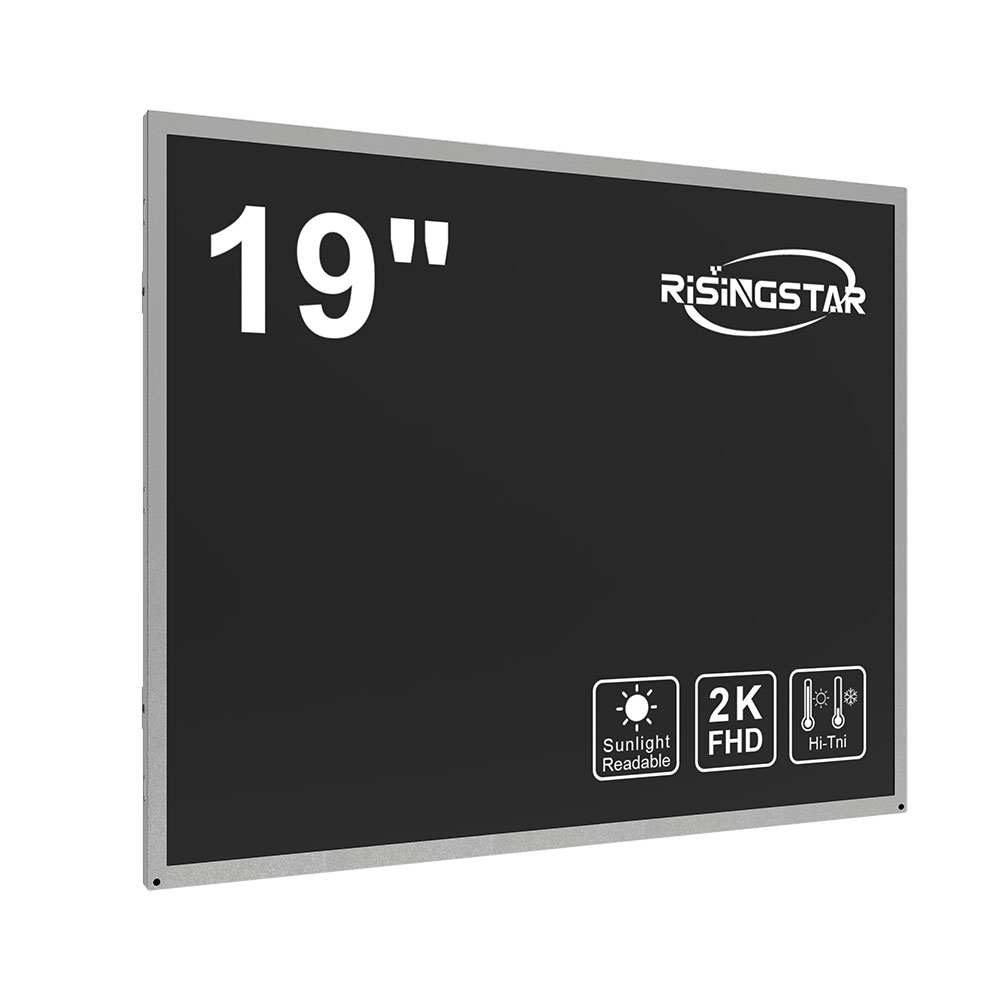
In the rapidly evolving landscape of display technology, high-brightness sunlight-readable LCD screens have become indispensable in industrial, military, automotive, and outdoor applications where visibility under direct sunlight is critical. When designing or selecting a display for such demanding environments—especially for 15", 17", and 19" screen sizes—the display ratio plays a pivotal role in both ergonomics and functionality. Among various aspect ratios, the 4:3 format remains highly relevant for professional-grade applications due to its compatibility with legacy systems, optimal text readability, and efficient use of space in control panels and embedded devices.
A 4:3 aspect ratio (commonly used in older computer monitors and still favored in specialized hardware) provides a more square-like viewing area compared to modern widescreen formats like 16:9. This makes it particularly advantageous in applications such as medical imaging, avionics, industrial automation, and field data terminals where vertical information density is key. For instance, a 17" 4:3 LCD can display more lines of code, sensor logs, or menu items without horizontal scrolling—critical for operators working in high-stress, fast-paced environments.
High-brightness sunlight-readable LCDs typically operate at luminance levels between 3,000 and 5,000 nits, far exceeding standard indoor displays that max out around 300–500 nits. These displays incorporate advanced technologies such as anti-reflective coatings, transflective liquid crystal cells, and active backlighting to ensure clarity even under direct solar exposure. Industry standards like MIL-STD-810G and IEC 60068-2-1 provide benchmarks for environmental durability, while ISO 9241-307 outlines human factors for outdoor usability.
Case studies from defense contractors and manufacturing firms show that using 4:3 17" displays in ruggedized field equipment reduces operator fatigue by up to 35% compared to widescreen alternatives due to better alignment with natural reading patterns. Similarly, in automotive dashboards, 15" 4:3 screens offer improved map readability and instrument cluster integration without compromising driver attention—a factor supported by research published in the IEEE Transactions on Human-Machine Systems.
Manufacturers such as ELO Touch Solutions, LG Display, and Innolux have developed proprietary solutions tailored to these form factors, offering features like wide temperature operation (-30°C to +70°C), IP65 dust/water resistance, and touch-enabled interfaces. For example, the 19" 4:3 model from ELO’s Series 9000 delivers 4,000 nits brightness, enabling reliable performance in extreme sun conditions—from desert environments to Arctic work sites.
When evaluating options for 15", 17", or 19" displays, engineers must also consider power efficiency, response time (<16ms), and long-term reliability. With global demand for rugged displays growing—projected to exceed $12 billion by 2027 according to MarketsandMarkets—choosing a 4:3 high-brightness LCD ensures both functional longevity and user-centric design. Whether deploying in mobile command centers, agricultural machinery, or public transportation systems, the right 4:3 display ratio is not just a preference—it’s a strategic advantage.