RisingStar
- Home
- About Us
- Products
- News
- Video
- Contact
- Send Inquiry
Search
- Home
- About Us
- Products
- News
- Video
- Contact
- Send Inquiry
RisingStar
In today’s increasingly mobile and outdoor-centric world, the demand for high-brightness sunlight-readable LCD screens has surged across industries such as transportation, defense, healthcare, industrial automation, and retail. These displays are engineered to remain fully visible under direct sunlight—a challenge that standard LCDs fail to meet due to low peak brightness levels (typically 300–500 nits) and poor contrast ratios in bright ambient lighting conditions. A high-brightness sunlight-readable LCD screen, by contrast, must deliver a minimum of 1,500 nits of luminance—often exceeding 5,000 nits in military-grade applications—to ensure readability under full sun exposure, even at extreme angles.
The technology behind these displays is multifaceted, involving innovations in backlighting, panel design, optical film stacking, and advanced driver circuits. Unlike conventional LCDs that rely solely on LED backlights with basic diffusers, sunlight-readable panels integrate specialized components like high-efficiency LEDs (often RGB or white LEDs with enhanced color temperature stability), micro-lens arrays, and anti-reflection coatings. These elements work together to boost brightness while minimizing glare and optimizing contrast, especially in environments where ambient light can exceed 100,000 lux—a level common in tropical or desert regions.
One of the most critical advancements in this domain is the use of transflective liquid crystal technology. Transflective displays combine reflective and transmissive modes: they reflect ambient light in bright conditions (like sunlight) to reduce power consumption, and switch to full transmissive mode when ambient light drops below a threshold. This dual-mode functionality significantly improves battery life in portable devices such as handheld medical scanners, ruggedized tablets used in field service, and military command units—all while maintaining visibility in varying lighting conditions. According to a 2023 study published in the Journal of Display Technology, transflective LCDs achieve up to 40% better power efficiency compared to traditional transmissive-only panels under outdoor scenarios.
Another key innovation is the integration of active matrix addressing with high-refresh-rate drivers. Traditional passive-matrix LCDs suffer from motion blur and poor response times, which become problematic in fast-moving vehicle dashboards or real-time control systems. High-brightness sunlight-readable displays now commonly employ IPS (In-Plane Switching) or AHVA (Advanced Hyper View Angle) panels paired with 60 Hz or higher refresh rates. These technologies not only enhance viewing angles but also reduce flicker and ghosting—critical for user comfort during prolonged outdoor use. For instance, in public transportation systems like bus GPS navigation units, such improvements directly translate into safer operation and reduced driver fatigue.
Environmental durability is equally vital. Many outdoor applications require displays rated IP65 or higher against dust and water ingress. Additionally, MIL-STD-810G certification ensures resistance to shock, vibration, temperature extremes (-30°C to +70°C), and humidity. In a case study conducted by CMOSS Inc., a leading manufacturer of industrial displays, a sunlight-readable LCD deployed in a construction site monitoring system endured over 1,200 hours of continuous operation under direct solar exposure without degradation in image quality. The display maintained consistent brightness and color accuracy across all test parameters, proving its reliability in harsh conditions.
Manufacturers have also adopted intelligent brightness control algorithms that dynamically adjust luminance based on ambient light sensors. This feature not only enhances readability but also extends component lifespan by reducing unnecessary power draw. For example, in an electric vehicle dashboard application, the system automatically lowers brightness when the car enters shaded areas, preserving battery life while ensuring optimal visibility when sunlight reappears. Such adaptive features are becoming standard in modern automotive infotainment systems, as mandated by ISO 9001 and IEC 60068 standards governing electronic equipment performance in variable environments.
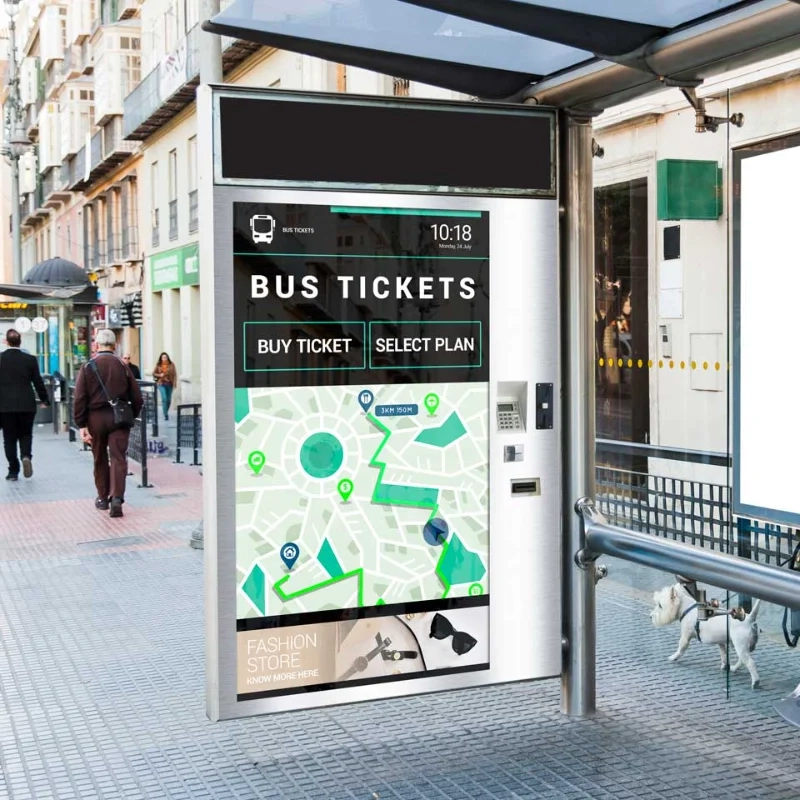
Furthermore, the rise of smart cities and IoT-enabled infrastructure has increased the need for robust, long-lasting displays in public kiosks, traffic signal interfaces, and emergency response equipment. In these contexts, failure to maintain readability under sunlight could lead to miscommunication, safety hazards, or operational delays. For instance, a 2022 report by the International Road Assessment Programme (iRAP) highlighted how poorly designed digital signage in urban areas contributed to driver confusion during peak sunlight hours. As a result, cities like Singapore and Barcelona now mandate the use of 5,000-nit sunlight-readable displays in their smart traffic management systems.
From a manufacturing perspective, producing high-brightness sunlight-readable LCDs involves precision engineering and stringent quality assurance processes. Companies like Sharp, LG Display, and BOE Technology Group invest heavily in R&D to develop ultra-thin polarizers, improved pixel structures, and next-generation quantum dot layers that enhance both brightness and color gamut. These materials enable manufacturers to produce displays that meet both consumer expectations and industry-specific requirements—for example, DICOM compliance for medical imaging or EN 55022 for electromagnetic compatibility in industrial settings.
In summary, the evolution of high-brightness sunlight-readable LCD technology represents a convergence of optics, materials science, software intelligence, and rigorous environmental testing. It addresses real-world challenges faced by users in diverse sectors—from soldiers in desert warfare zones to engineers inspecting offshore oil rigs—and continues to evolve through collaborative efforts between academia, government agencies, and private sector innovators. With ongoing developments in OLED-based sunlight-readable solutions and flexible display architectures, the future promises even more efficient, durable, and versatile options tailored for tomorrow’s demanding outdoor environments.