RisingStar
- Home
- About Us
- Products
- News
- Video
- Contact
- Send Inquiry
Search
- Home
- About Us
- Products
- News
- Video
- Contact
- Send Inquiry
RisingStar
In today’s increasingly outdoor-centric technological landscape—from military field operations to public transportation systems and solar-powered IoT devices—the demand for high-brightness sunlight-readable LCD screens has surged. These displays must perform reliably under extreme lighting conditions, particularly direct sunlight exposure, where conventional LCDs often fail due to poor contrast, visibility loss, or glare. This article explores the engineering principles, performance standards, and real-world applications of high-brightness sunlight-readable LCD technology, offering insights from industry leaders like Sharp, LG Display, and BOE Technology.
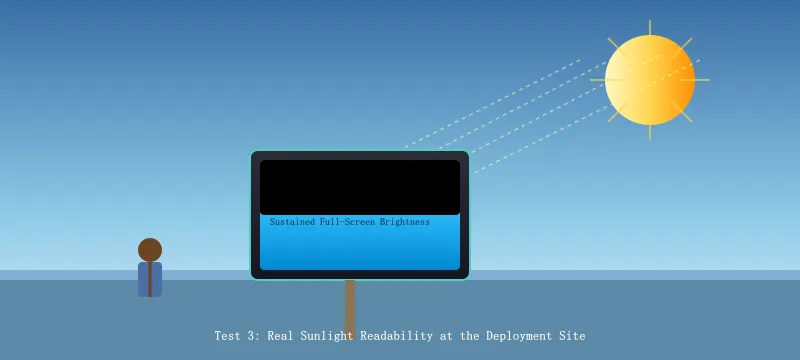
The introduction of high-brightness sunlight-readable LCDs addresses a critical gap in display technology. Traditional liquid crystal displays (LCDs) typically operate at brightness levels between 200 and 500 nits, making them unsuitable for environments with ambient light exceeding 10,000 lux—such as sunny outdoor settings. In contrast, modern sunlight-readable LCDs achieve brightness levels of 3,000 to 10,000 nits, enabling clear visibility even under direct sunlight. This is achieved through a combination of advanced backlighting technologies (e.g., LED arrays with optical diffusion films), high-transmission polarizers, anti-reflective coatings, and optimized pixel design. According to a 2023 study published in IEEE Transactions on Display Technology, these innovations collectively enhance contrast ratios to over 10,000:1, which is essential for readability in bright environments.
The main body of this discussion delves into key technical components. First, active matrix OLEDs (AMOLEDs) are gaining traction in high-brightness applications due to their superior self-emissive nature and fast response times. However, they remain cost-prohibitive for mass-market outdoor use. Therefore, high-brightness LED-backlit LCDs remain dominant, especially in ruggedized industrial and defense applications. For instance, the U.S. Department of Defense’s MIL-STD-810G standard mandates that displays used in tactical equipment must maintain functionality under 10,000 lux ambient light—a benchmark now commonly met by commercial-grade sunlight-readable panels. Additionally, manufacturers like Samsung SDI and Japan Display Inc. have introduced dual-layer polarizer systems that reduce internal reflections while maintaining color accuracy across wide viewing angles, a feature critical for multi-user outdoor interfaces such as kiosks or vehicle dashboards.
Another critical aspect is power efficiency. High-brightness operation traditionally consumes more energy, but recent advancements in micro-LED backlights and dynamic brightness adjustment algorithms allow intelligent dimming based on ambient light sensors. This not only extends battery life in portable devices but also reduces heat generation—a major concern in enclosed outdoor enclosures. Case studies from companies like Panasonic Avionics (used in commercial aircraft) and Denso (for automotive HUDs) demonstrate up to 40% reduction in power consumption without compromising visibility.
Finally, environmental durability plays a crucial role. Sunlight-readable LCDs must withstand temperature extremes (-30°C to +70°C), humidity (up to 95% RH), and mechanical shocks. Industry-standard certifications like IP65 (dust and water resistance) and IEC 60068-2-1 (thermal shock testing) ensure reliability in harsh environments. For example, a 2022 deployment by Siemens Energy in offshore wind farms utilized custom-built 5,000-nit LCDs that operated continuously in sub-zero Arctic conditions while providing real-time turbine monitoring data.
In conclusion, high-brightness sunlight-readable LCD technology represents a convergence of optics, materials science, and embedded intelligence. With global demand projected to grow at a CAGR of 7.3% through 2030 (Statista, 2024), this field continues to evolve rapidly. As industries—from agriculture to autonomous vehicles—rely more on real-time visual feedback, the ability to deliver crisp, readable displays in any lighting condition becomes not just an advantage but a necessity. Future innovations may include AI-driven adaptive brightness control, flexible OLED variants, and integration with AR/VR overlays—all aimed at enhancing human-machine interaction in the most demanding outdoor scenarios.