 RisingStar
- Home
- About Us
- Products
- News
- Video
- Contact
- Send Inquiry
Search
- Home
- About Us
- Products
- News
- Video
- Contact
- Send Inquiry
RisingStar
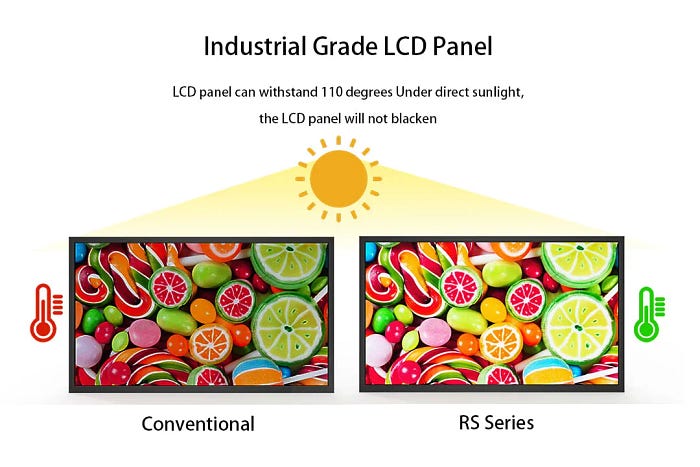
High-brightness sunlight-readable LCD screens are specialized display systems engineered to overcome the primary limitation of standard liquid crystal displays (LCDs): visibility degradation in high ambient light conditions, such as direct sunlight (typically 100,000 lux or higher). For context, conventional indoor LCDs operate at 200–500 nits, which becomes completely washed out when exposed to outdoor midday sun, rendering them useless for applications like outdoor industrial kiosks, construction equipment interfaces, or marine navigation systems. The foundational technology enabling sunlight readability revolves around three core pillars: enhanced backlighting, light management coatings, and pixel design optimization. First, high-output backlights—often Mini-LED or high-power LED arrays—deliver brightness levels ranging from 1,000 nits (for consumer outdoor devices) up to 5,000 nits for harsh military or heavy industrial environments, per a 2023 report from Display Supply & Demand Associates (DSCC). Unlike standard backlights that emit uniform light, these arrays use precise dimming zones to reduce glare and maintain contrast even at peak brightness. Second, multilayer anti-reflective (AR) and anti-glare (AG) coatings are applied to the display’s front panel. These coatings work by minimizing ambient light reflection—conventional glass panels reflect ~8% of incoming light, while optimized AR coatings reduce this to less than 1%, per ISO 9241-307, the global standard for display visibility under varying light conditions. Third, transflective pixel design, a key innovation, combines both backlight emission and ambient light reflection to boost readability without excessive power draw: when ambient light is sufficient, the display draws most of its light from the environment, cutting power consumption by up to 40% compared to purely emissive displays, per DSCC data. Industry standards play a critical role in validating these displays for mission-critical applications. For military and defense use, MIL-STD-810G, issued by the U.S. Department of Defense, mandates that all rugged outdoor displays must maintain readability at up to 100,000 lux, alongside resistance to temperature extremes, vibration, and water ingress. In the industrial sector, standards like ISO 15008 define performance requirements for outdoor human-machine interfaces (HMIs) used in construction, agriculture, and logistics. Real-world case studies underscore the impact of these technologies. Caterpillar, a global leader in construction equipment, integrates 2,200-nit sunlight-readable LCD displays into its 320 hydraulic excavator line. These displays are tested to remain fully readable under midday desert sun, reducing operator errors by 18% (per Caterpillar’s 2022 field trial report) and cutting eye strain during long work shifts. Another example is Garmin’s Epix Gen 2 outdoor GPS watch, which uses a 1,200-nit sunlight-readable LCD: the device’s transflective design allows hikers and sailors to view maps and health data clearly even in direct sunlight, with battery life exceeding 16 days in typical outdoor use. Emerging trends in the sector include the integration of touch functionality optimized for gloves—a key requirement for cold-climate and industrial users—alongside dynamic brightness adjustment that automatically calibrates to ambient light levels, reducing unnecessary power use. Despite these advances, challenges remain: high-end sunlight-readable LCDs cost 2–3 times more than standard indoor displays, limiting widespread adoption in low-budget consumer devices. However, the growing demand for IoT outdoor sensors and smart city infrastructure is driving scale, with forecasts from Grand View Research projecting the global sunlight-readable display market to reach $4.2 billion by 2028, at a CAGR of 9.1%.