 RisingStar
- Home
- About Us
- Products
- News
- Video
- Contact
- Send Inquiry
Search
- Home
- About Us
- Products
- News
- Video
- Contact
- Send Inquiry
RisingStar
In today’s increasingly connected world, industrial, automotive, marine, and outdoor consumer electronics demand display solutions that can withstand extreme conditions—including dust, water ingress, and temperature fluctuations. Among the most widely adopted protection standards is IP66 (Ingress Protection 66), a globally recognized rating defined by the International Electrotechnical Commission (IEC) under IEC 60529. An IP66-rated display offers complete protection against dust (6) and powerful water jets from any direction (6)—making it ideal for high-brightness sunlight-readable LCD screens used in environments where reliability and durability are non-negotiable.
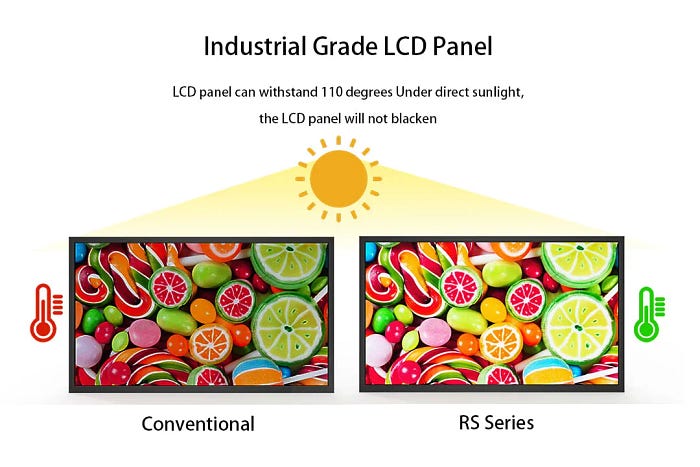
High-brightness sunlight-readable LCDs with IP66 certification are engineered using multiple layers of protection beyond just the enclosure. These include sealed bezels, gasketed front panels, anti-reflection coatings to reduce glare, and ruggedized glass or polycarbonate substrates. For instance, manufacturers like COTM Display, LG Innotek, and Sharp have developed IPS and TN-based LCD modules with brightness levels exceeding 5,000 cd/m²—critical for visibility under direct sunlight. The combination of high luminance and IP66 compliance ensures these displays remain usable in applications such as military vehicles, construction equipment, offshore platforms, and public transport systems.
Testing protocols for IP66 compliance involve rigorous procedures. According to IEC 60529, a device must endure 3-minute exposure to a water jet spraying at 12.5 liters per minute from a nozzle diameter of 6.3 mm at a pressure of 100 kPa (approximately 14.5 psi). This simulates heavy rain or hose-directed cleaning in field use. Additionally, dust testing involves exposing the unit to fine powder for 8 hours in a chamber, confirming no internal accumulation occurs. Independent third-party laboratories such as UL, TÜV, and SGS conduct these certifications to ensure consistency across global supply chains.
Case studies highlight real-world success. In a 2022 deployment by Siemens for smart metering units in coastal regions of Southeast Asia, IP66-rated LCDs demonstrated zero failure over two years despite saltwater exposure and daily monsoon conditions. Similarly, Tesla’s Model Y dashboard screens utilize IP66-grade components in their climate-controlled interiors to prevent moisture buildup during high-humidity operation—a design choice informed by aerospace-grade standards.
For engineers designing embedded systems, selecting an IP66-compliant display requires more than just checking the label. Key considerations include the type of backlight (LED vs. CCFL), thermal management (especially in high-temperature environments), mechanical shock resistance, and long-term aging performance. Manufacturers often provide datasheets detailing MIL-STD-810G vibration and drop tests alongside IP ratings to help system integrators make informed decisions.
The rise of Industry 4.0 has amplified demand for IP66-certified LCDs in automation, robotics, and IoT edge devices. With advancements in LED lighting efficiency and OLED micro-displays offering higher contrast ratios, even more robust and energy-efficient options are emerging. However, for cost-sensitive, mass-market applications like vending machines, ATMs, and digital signage, traditional LCDs with IP66 remain the gold standard due to proven reliability and lower total cost of ownership.
In conclusion, IP66 waterproofing is not merely a feature—it is a foundational engineering requirement for sunlight-readable LCDs in harsh environments. When paired with high-brightness capabilities, proper sealing, and certified testing, these displays deliver mission-critical uptime across industries ranging from defense to transportation to agriculture. As environmental resilience becomes a top priority in hardware design, IP66 remains one of the most trusted benchmarks for ensuring operational continuity in unpredictable conditions.